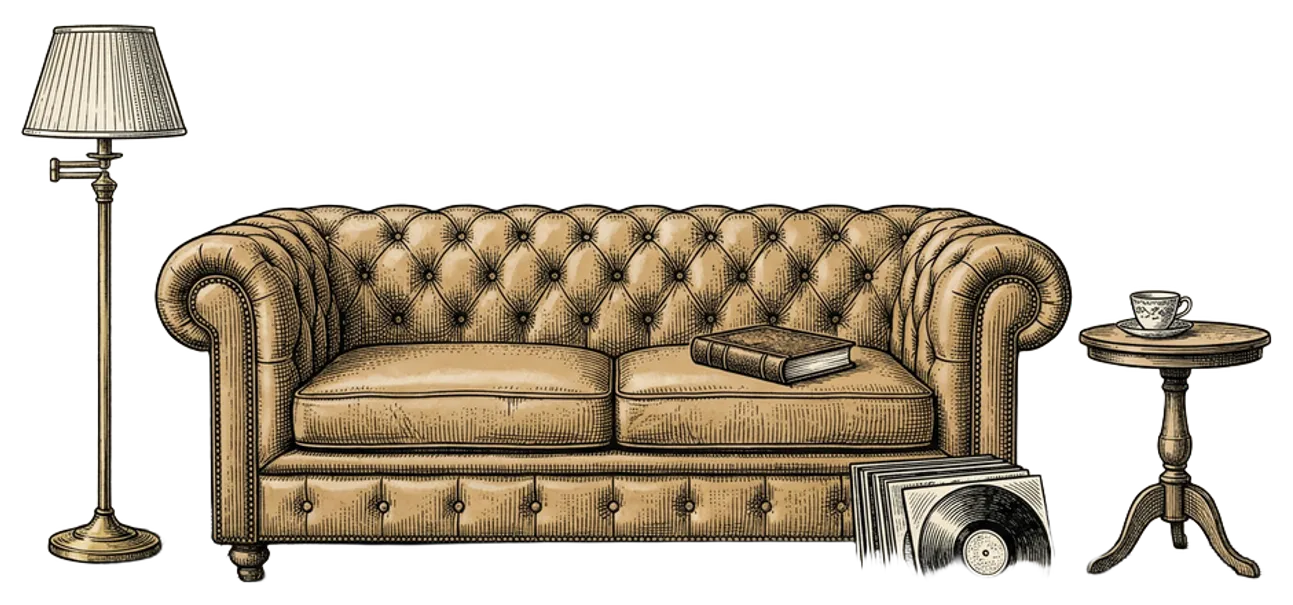



The common objection to the analog-home idea is reasonable: that sounds nice for people with a study, a spare bedroom, and square footage to spare.
But an analog home does not begin with a room. It begins with a boundary.
In a small apartment, the same space may be an office at noon, a dining room at six, and a living room at eight. The point is not to pretend otherwise. The point is to give one part of that space a clear job when the workday is over.
Make a zone, not a fantasy room
Choose a place you can protect for one offline activity. It might be a single chair, the end of a dining table, a window seat, a balcony, or the side of the bed that is not occupied by a charger.
Give it three things:
- a purpose: reading, listening, drawing, conversation, or simply sitting;
- a cue: a lamp, a blanket, a cup of tea, or a record;
- a boundary: no phone, no laptop, no television within reach.
This is enough. A zone used consistently becomes legible to you. It begins to say, without much effort, this is where I read or this is where the day slows down.
Let storage do some of the work
Small spaces tend to fail when every activity has to be assembled from scratch. Put the things you want to do where you can see them, and put the things you want to do less of somewhere inconvenient.
Keep a small basket or lidded box with a book, cards, notebook, pen, and headphones for non-screen listening. Keep the phone charger in the hall, kitchen, or another room. Use a tray to clear a table in two minutes when it is time to eat or play a game.
The goal is not immaculate minimalism. It is a home that can change modes without becoming an argument with your possessions.
Do not make the phone the center of the room
In a compact home, the phone can seem impossible to escape because it is needed for work, directions, payments, and messages. That is precisely why it needs a designated landing place.
Try a simple rule: when you enter the analog zone, the phone goes to its charging place—not face-down beside you. If you need it for an anticipated call, let the call be the exception and return it afterward. A boundary can be flexible without becoming invisible.
Choose one small ritual
Do not schedule a perfect screen-free evening. Start with fifteen minutes after dinner or the first ten minutes after waking. Read two pages. Listen to one side of a record. Write a few lines. Water the plants. Sit on the balcony without bringing the phone.
The ritual is not there to make you virtuous. It gives the space a reliable beginning, which is often the hardest part.
The small-apartment test
After two weeks, ask one question: Did I go there?
If not, change the space rather than blaming yourself. The chair may be uncomfortable. The lamp may be too harsh. The activity may be too ambitious. A good analog zone is not the one that photographs well; it is the one you return to without negotiating with yourself.
For the larger philosophy, start with The Analog Home. If you have a whole room to work with, read The Analog Room, Examined.