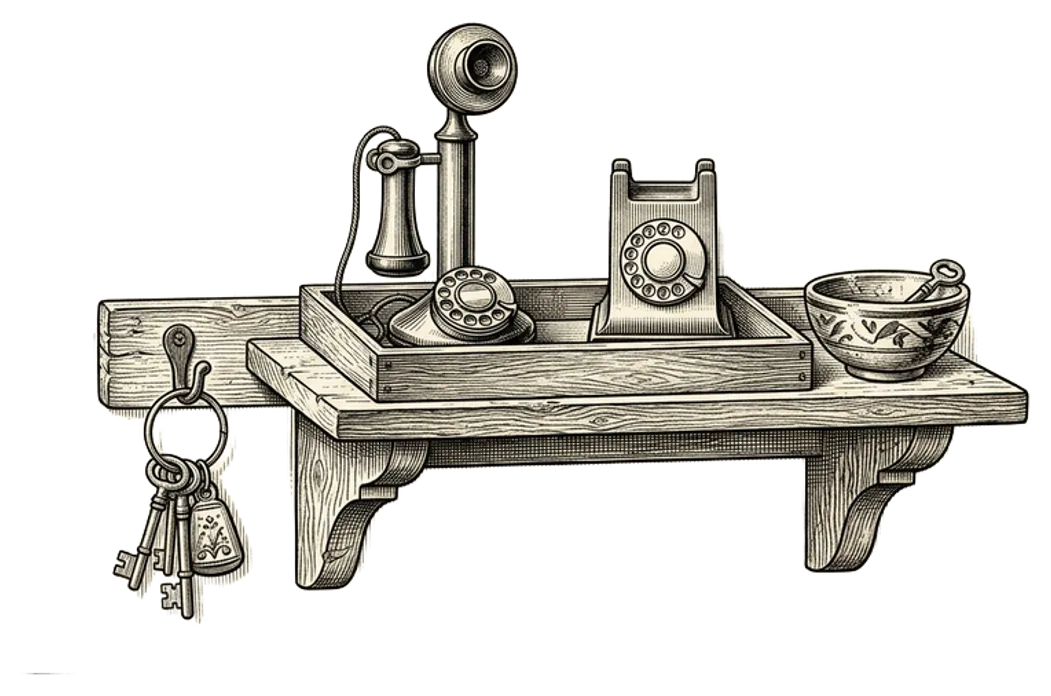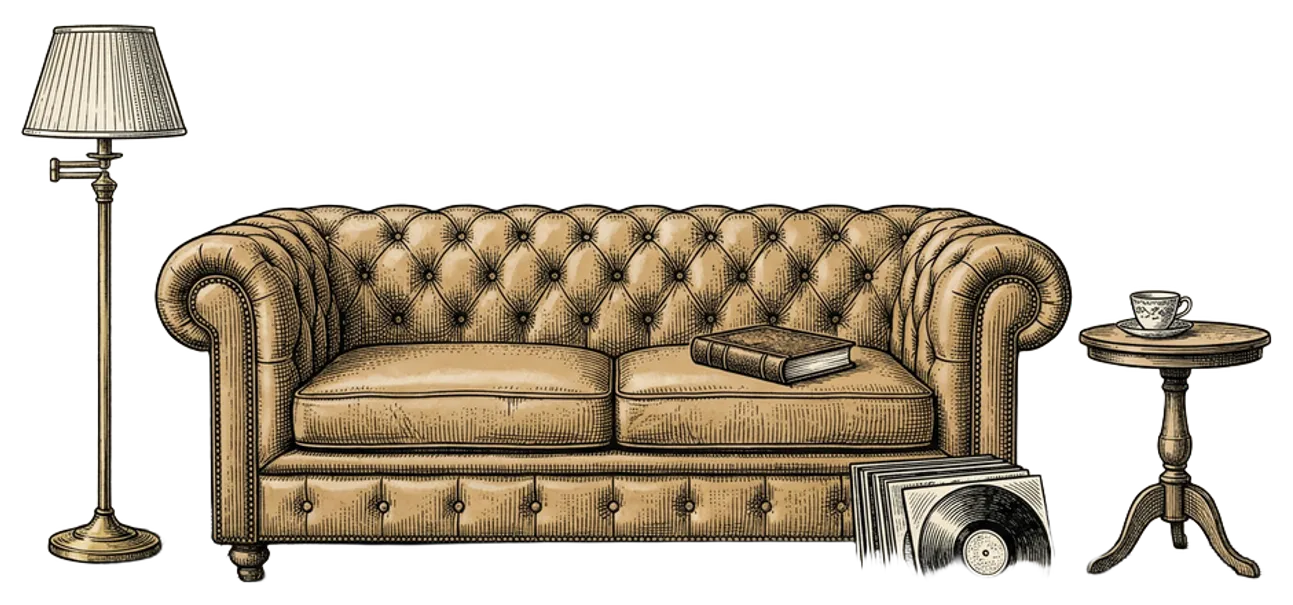


The phrase analog home is suddenly everywhere.
It appears beside record players, paperback novels, board games, soft lamp light, old cameras, and a certain kind of 1970s warmth. It is often presented as an interiors trend: a little nostalgia, a few tactile objects, perhaps a beautiful room in which no one appears to have a charger.
That is the surface of it. The deeper idea is more useful.
An analog home is not a house without technology. It is a home in which technology has been put back in its proper place: useful, bounded, and no longer the default activity in every room.
It is a home with places where your attention is not for sale.
That can mean a whole screen-free room. It can mean a bedroom where the phone charges elsewhere, a dining table that stays clear of devices, a chair reserved for reading, or one hour after dinner that belongs to conversation, music, a puzzle, a sketchbook, or nothing much at all.
The goal is not to return to 1984. It is to make room for the parts of life that a permanently connected house tends to crowd out.
First, a definition
An analog home is a home deliberately arranged to make offline life easier to begin and easier to continue.
It rests on three ideas:
- Some boundaries are physical. A phone in another room is different from a phone turned face-down on the table. A television behind closed doors is different from one that dominates the living room, even when it is off.
- The room suggests the behavior. A comfortable chair with a nearby lamp and a book already in progress makes reading more likely. A clear table with cards in a drawer makes a game easier to start.
- The alternative has to be ready. "Use your phone less" is not a plan. A book, notebook, deck of cards, puzzle, instrument, garden, recipe, or person in the room gives the hand and mind somewhere else to go.
The rest—wood, linen, plants, film cameras, vintage furniture—is optional.
What an analog home is not
It is not a performance of nostalgia. You do not need a rotary phone, a typewriter, a perfect vinyl collection, or a room arranged for photographs. You do not need to replace working things with less convenient ones. And you do not need to feel guilty for using a laptop to work, a phone for directions, or a television to watch a film you love.
It is also not a medical treatment or an argument that every screen is bad. Research on screens, sleep, attention, and well-being is real but complicated; context and timing matter. Bedtime device use is associated with poorer sleep outcomes, while one controlled study found benefits when participants restricted phone use before bed. The fair conclusion is not that a phone ruins sleep. It is that the bedroom is a sensible place to make the phone less available.
The honest case is simpler: constant availability makes it harder to be fully present. A home can make that problem worse—or it can help.
Why the analog home is taking hold now
The rise of the analog home is a response to a strange fact of modern domestic life: the place where people once recovered from the day is now often where the day continues.
Work messages arrive in the kitchen. News reaches the bedroom. The same device that holds family photographs also offers an infinite feed designed to prevent an ending. Smart-home convenience can be genuinely useful, but it can also leave a house full of prompts, alerts, microphones, glowing screens, and things that demand attention.
So the appeal is not simply old things. It is friction in the right places.
Vinyl asks you to choose an album. Paper asks you to stay with a page. A board game asks people to sit down together. A physical camera makes a photograph feel finite again. A room without a television creates the possibility of a conversation that does not have to compete with one.
These things are not morally superior. They simply make a different kind of life easier.
The five parts of an analog home
You do not need all five. Start with the part that would make the greatest difference in your actual life.
1. A place to put the phone away
Every analog home needs a practical answer to one question: where does the phone go when it is not needed?
Make the answer visible and easy: a charging station outside the bedroom, a basket or drawer near the entry, or a shelf in the kitchen that is not the dining table. This is more important than buying any object for an analog space. Without a physical home for the phone, every screen-free intention becomes a repeated act of willpower.
2. A room—or zone—without screens
A dedicated analog room is the clearest form of the idea, but it does not require a spare bedroom or a large home. It can be one reading chair beside a lamp, a table for cards or drawing, a porch, a balcony, or a bedroom reclaimed for sleep and reading.
The one rule is simple: screens do not live there. Not in a pocket, not face-down on the arm of the sofa, not "just in case." For the full method, read The Analog Room, Examined.
3. Objects that invite participation
The best analog objects are not decorative symbols of a better life. They are things you actually touch. Keep a book in progress, a notebook and a pen that works, a deck of cards, an unfinished puzzle, a small radio, a camera, or art supplies within reach.
The test is practical: when you have ten idle minutes, does the room offer something better than opening an app?
4. A calmer approach to sound and light
An analog home does not need to be silent. It needs to feel less demanding. Choose light that can be adjusted: a reading lamp, a small table lamp, warm bulbs, light that belongs to an activity rather than floods the whole room. Let music be something you choose, not merely a soundtrack supplied by an algorithm.
5. Rituals that give the space a purpose
A room becomes meaningful through repetition. Make a small ritual around entering it: tea after dinner and twenty pages of a book; Sunday morning records; a weekly card game; ten minutes of writing before work; a phone-free family meal.
The ritual does not need to be impressive. It only needs to happen often enough that the space begins to mean something.
Start with subtraction, not shopping
The quickest way to make an analog home is to remove one source of interruption.
Take the television out of one room. Move the charger out of the bedroom. Put a basket for phones by the dining table. Cancel the notification that never needed to exist. Clear a surface and place a notebook, a book, or a game there instead.
Then live with the change for two weeks.
If you use the space, improve it. Add the chair, lamp, shelf, record player, or whatever makes the habit more enjoyable. If you do not use it, do not blame yourself or buy your way out of the problem. Ask what is missing: comfort, light, time, a clear activity, or simply a realistic expectation.
The analog home is not a renovation project. It is a series of small decisions about what deserves a place in your day.
A home that gives something back
The promise of an analog home is not purity. It is not productivity. It is not an escape from modern life.
It is a home that does not take every spare moment from you.
A home where the evening has edges. A home where a conversation can continue without a notification cutting through it. A home where a book can become absorbing again, where music can be listened to, where boredom has enough room to become thought.
Start with one place. Make it easy to enter. Keep the screen out.
Then notice what comes back.