
The analog home is often misunderstood as an anti-technology project. It is not.
Technology can make a home safer, more accessible, less wasteful, and easier to manage. A thermostat that reduces energy use, a doorbell camera that helps a homeowner feel secure, a medical alert device, an appliance timer, or an accessibility tool can be quietly valuable.
The question is not whether a device is digital. The question is whether it serves the household without demanding to become part of every moment in it.
The useful distinction: invisible versus intrusive
Good household technology tends to disappear into the background. It does its job and then leaves you alone.
Intrusive technology creates more choices, notifications, subscriptions, screens, maintenance, and reasons to pick up the phone. It can turn a simple task—changing a light, playing music, answering a door—into another interface to manage.
This is not universal. One person's useful automation is another person's unnecessary complication. But the distinction gives you a fair way to decide.
Ask of any device:
- Does it save time or create a new task?
- Does it reduce worry or give me another thing to monitor?
- Can it work without my phone in hand?
- Is it quiet when I do not need it?
- Would I miss the function, or only the novelty?
Keep the essential things understandable
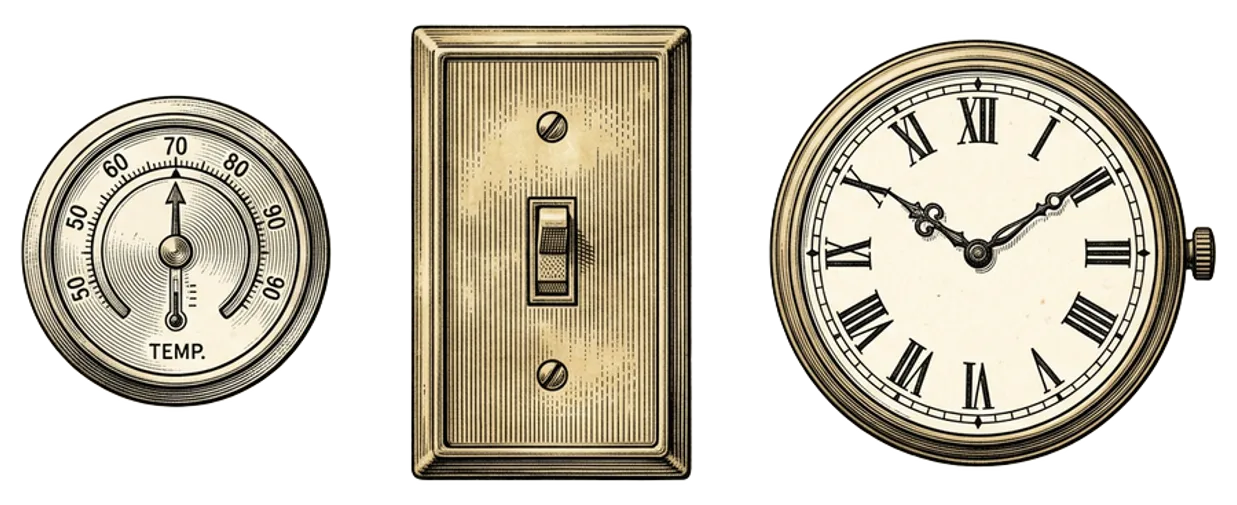
An analog home benefits from a little redundancy. A physical key as well as a smart lock. A manual way to turn on a light. A thermostat that can be adjusted without an app. A paper list of important numbers and instructions where the household can find it.
This is not paranoia or a rejection of convenience. It is ordinary resilience. Homes are easier to live in when basic functions are understandable even when Wi-Fi is down, an app changes, or the person who installed everything is away.
Make the technology earn its place
You do not need to remove every smart device. Start by turning off the notifications that do not matter, removing a screen from a room where it provides little value, and choosing fewer systems that work well over many systems that compete for attention.
An analog bedroom might still have an air purifier. An analog kitchen can have a digital timer. A quiet living room can have a television that is concealed, unplugged from autoplay, or simply used deliberately. The boundary is not about the age of the tool. It is about whether the tool takes over the room.
The aim is a home that feels like a place you inhabit—not a collection of devices asking to be managed.
For the practical foundation, begin with The Analog Home and The Analog Room, Examined.