



There is a particular kind of person who decides, on a Sunday night, that they are going to do a digital detox. They announce it. They post about it (one last time). They delete the apps with a small flourish. They install a website blocker. They set the phone to grayscale. They tell their partner.
By Thursday, the apps are back. By the following Sunday, the experiment is folklore. They will tell the story self-deprecatingly at dinner parties for the next year.
This piece is not for that person — or rather, it is for that person, but only if they are willing to consider that the reason it didn't work the first time wasn't a failure of willpower. It was a failure of design. They tried to do too much, too fast, and they made it a performance, and the performance is the part that collapses.
What follows is a calmer way. It is a ladder, not a cliff. It starts with one rung that almost anyone can stand on, and goes up gradually toward "the phone lives in a drawer most of the day." You can stop at any rung. Most people should. The point is not to be impressive about it. The point is to feel like the owner of your own attention again.
What a digital detox actually is — and what it isn't
The term has been worn out by wellness influencers and corporate-retreat packages. Let's pin down what we mean.
A digital detox, as we mean it, is a deliberate, sustained reduction in the amount of attention you give to devices that are designed to extract attention. The keyword is designed. You are not fighting a neutral tool. You are pulling back from products built by very smart people whose paychecks depend on you using those products more. That asymmetry is not your fault, and noticing it is not paranoia. It is simply the situation.
A digital detox is not:
- A weekend in a cabin without Wi-Fi (that's a vacation).
- Quitting the internet (impossible, mostly undesirable).
- A productivity hack to get more work done (related, but smaller in scope).
- A moral position about technology (it isn't; some technology is good, some isn't, this isn't church).
- A diet (diets fail; sustainable changes don't).
A useful digital detox is something closer to deliberately rearranging the furniture of your daily life so that your phone has to walk further to reach you. Some rooms it doesn't get invited into. Some hours it doesn't get to speak. The goal is not to perform abstinence. The goal is to feel like the owner of your own attention again.
Why most attempts fail
Before the ladder, the diagnosis. Most digital detoxes fail for one or more of four reasons, all of which are designable around.
They try to change everything at once. A person on Sunday night who deletes six apps, installs a blocker, sets grayscale, and tells themselves they will not look at a screen after 8 PM is not making one decision. They are making twenty decisions, all of which require willpower at the moment of execution. By midweek the willpower budget is gone. The fix is obvious in retrospect: change one thing at a time, in order of difficulty, lowest first.
They are framed as denial rather than redesign. "I am not going to look at Instagram" is a denial; you will think about Instagram constantly. "Instagram is not on my phone anymore, so I cannot look at it from the couch" is a redesign; you will think about Instagram less because the path to it now requires a laptop and a deliberate login. Redesign beats discipline.
They are performed publicly. Telling everyone you are doing a detox makes the detox into a piece of social-media content, which is the exact failure mode the detox was supposed to address. Do it quietly. Tell your spouse. Don't tell anyone else for at least a month.
They aim for purity instead of for sustainability. A detox you can sustain for ten years beats one you can sustain for ten days. The goal isn't to achieve a perfectly clean state. The goal is to push the curve down a notch in a way you don't have to think about every day.
The ladder
Eight rungs, lowest to highest. Read all of them before you do anything. Then pick one rung — one — and stand on it for two weeks. After two weeks, decide whether to climb. Most people will find the right rung is lower than they expected, and that is a feature, not a failure.
Rung 1 — Move three apps off your home screen.
The smallest possible change, and the one I would bet money is the most effective per unit of effort. The home screen is real estate, and every app on it is there because someone — you, your past self, a default setting — decided it should be one tap away. Most of those decisions were not deliberate.
Take the three apps you find yourself opening without remembering opening them. For most people this is some combination of Instagram, TikTok, X, Reddit, email, Slack, or YouTube. Move them off the home screen entirely. Put them in a folder on the last page, or use your phone's app library, or delete them and access via browser. The point is: they should require three deliberate taps to reach, not one.
That single change — for many people, this is the only rung they ever need — reduces use of those apps by something like a quarter to a third in our experience, with no willpower involved. You are not refusing to open the app. You are just no longer being invited to open it every time you unlock your phone.
Rung 2 — Turn off notifications for everything that isn't a person.
Open settings. Go through every app. Turn off notifications for anything that isn't a human being trying to reach you directly. Your bank does not need to interrupt you. Your social-media apps do not need to interrupt you. News apps especially do not need to interrupt you.
Keep notifications on for: phone calls, text messages, calendar events, and direct messages from apps you actually use for human conversation. Turn off everything else. All of it. The category of "alerts from apps that want your attention so they can sell it" should produce zero pings from your phone forever.
This rung pairs well with Rung 1 and they should probably be done together if you're going to do either.
Rung 3 — Charge your phone outside the bedroom.
There is a slightly tired piece of advice in the wellness world that says you should charge your phone in another room overnight. It is tired because everyone has heard it. It is also correct. The reason it works is not about sleep hygiene (though that's real) — it's that the first thing you do in the morning sets the tone of your attention for the day, and "check phone before feet hit the floor" is a tone-setter that compounds.
Buy a cheap analog alarm clock if you used your phone for that. Put the phone on a charger in the kitchen, the hallway, the bathroom — anywhere that isn't arm's reach of your pillow. Do this for two weeks before judging.
If you have small children and need your phone in the room for night-time reasons, that's a fair exception. Make it a real exception, not a permanent one.
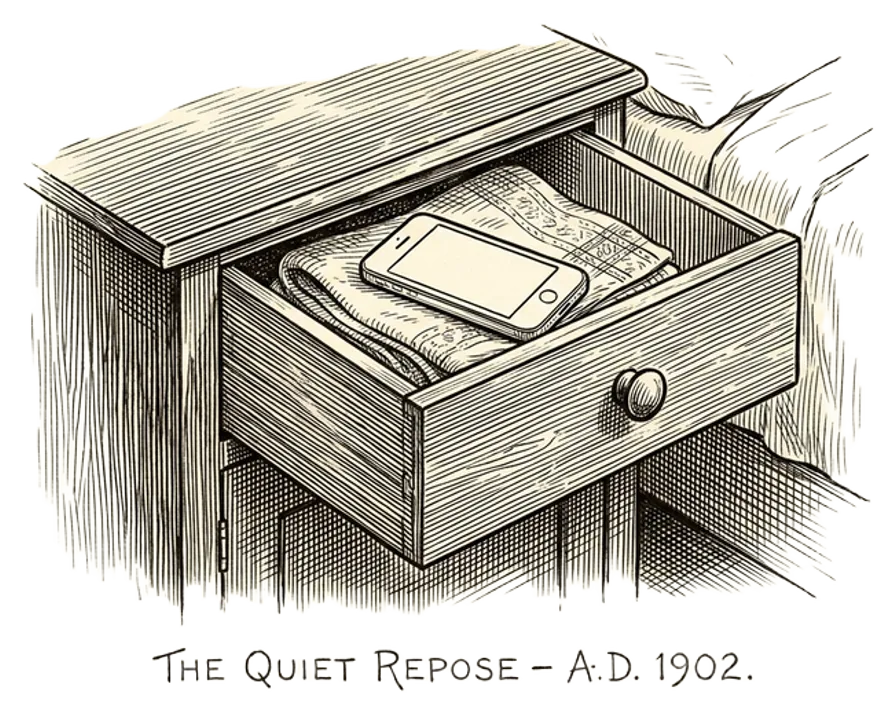
Rung 4 — Pick one hour a day that the phone is in a drawer.
Not a vague intention. A literal hour, a literal drawer. The first hour of the day, the last hour before bed, the hour you eat dinner with your family — pick whichever fits your life. The phone goes into a closed drawer in another room for sixty minutes. The world will keep turning.
This rung is harder than the first three because it requires you to feel the absence. The first day or two you will reach for the phone half a dozen times before remembering. That feeling is information. It tells you something about the relationship that you can't see from inside it.
Most people, on the other side of the first week, report that the drawer-hour is the calmest hour of their day. Some people end up wanting two drawer-hours. A few extend it further. You don't have to. One is plenty.
Rung 5 — Replace one daily task that's on the phone with something that isn't.
Pick one. Reading the news in bed → a physical newspaper or a printed magazine over breakfast. Listening to a podcast → a record on the stereo, twice a week. Capturing thoughts in Notes → a small paper notebook in your back pocket. Setting reminders → a wall calendar and a pen. The kitchen timer → a kitchen timer.
The point is not nostalgia. The point is that each of those non-phone replacements is a tool that does one thing and then stops. The phone is a portal to twenty things, and each of the twenty things is competing for the next forty minutes of your attention. The record player is a record player. It plays the record. It does not also try to sell you on next week's record.
This is the rung where the home starts to feel quieter, because you are putting tools back in the spaces where there used to be a phone.
Rung 6 — One screen-free day a week.
A whole day. The phone is on but in a drawer. You can answer real emergencies. You don't check email. You don't scroll. You do whatever a person did on a Sunday in 1992 — read, cook, walk, see people in person, sit on a porch.
The first one is hard, the second is easier, the third you start to look forward to. Most people who get to rung six say it becomes the best day of the week within a month. We're going to take their word for it because it's been true in our own lives too.
Pair this with telling no one. The Sabbath was not a brand. Yours doesn't have to be either.
Rung 7 — Audit your devices, not just your apps.
This is the rung where you look up from the phone and notice everything else. The smart speaker in the kitchen — we wrote a whole piece about that one. The smartwatch buzzing on your wrist. The smart TV that's quietly logging what you watch. The thermostat reporting home occupancy back to a server.
You don't have to throw any of these away. You do have to see them — to ask, for each, what it actually does for you, what it costs you in attention or surveillance, and whether you'd buy it again today knowing what you know. Some you'll keep. Some you'll move out of the central rooms of the house. Some you'll unplug and discover, two weeks later, that you don't miss.
The smart-speaker question alone is worth its own afternoon. The smartwatch question is worth a week.
Rung 8 — Consider a different phone.
This is the high rung and it is not the right rung for most people. But for some people — usually those who got to rung six and felt a real change and want more of it — the question becomes whether the phone itself is the thing.
There are middle paths between "iPhone with everything" and "no phone at all." A second, simpler phone for evenings and weekends. A purpose-limited device like the Light Phone for periods when you want fewer affordances. The iPhone you already own with most of the apps deleted and Screen Time configured strictly. There's an honest comparison of these paths elsewhere on the site.
The honest pick for most readers at this rung is not a new phone. It's the phone you already own, set up for a smaller life. New devices are tempting because they feel like progress. Usually the progress is structural, not gadgetary.
What to expect, week by week
Roughly, in our experience and in the experience of friends:
Week 1 is uncomfortable. Whatever you reduced, you'll feel the absence. You'll reach for the phone reflexively and find your hand surprised. The discomfort is real and it is also the entire point — that surprise is the moment you can see, for the first time in a while, the shape of the habit you were not noticing.
Week 2 is quieter. The reflex starts to fade. You'll have more small idle moments in your day — standing in line, waiting for a kettle — and you'll be slightly less sure what to do with them. That uncertainty is good. Idle moments are where thinking happens. We've been filling them with content for so long we forgot they were there.
Week 3 you'll notice you read more. This is consistent enough across people we know to be almost a rule. The hour you used to spend on the phone before bed becomes the hour you read a book. Books that have been on the shelf for two years start getting finished.
Week 4 you'll have to decide whether to go up a rung. Don't, unless you genuinely want to. The point is not the climbing. The point is the rung where your attention feels like yours again. Whatever rung that turns out to be is the right one. We've known people who never went past Rung 2 and were perfectly happy. We've known people who ended up at Rung 7 and were perfectly happy. The rung doesn't matter. The ownership does.
A few things we won't tell you to do
For balance — because most articles on this topic over-promise — here are some popular tactics we've found unhelpful, even when they sound reasonable.
Grayscale. Setting your phone to black and white. The theory is good (apps look less appealing without color). In practice, most people last about three days and the apps win anyway because the dopamine is in the content, not the saturation. Save the effort.
Detox apps. Apps that block apps. The recursive irony is hard to ignore. Some people find them useful as a temporary scaffold; most people stop opening them within a week.
A 30-day cleanse. Time-bounded extreme programs ("no phone for a month!") often work for the month and then snap back hard, because nothing structurally changed. The ladder above is designed to be permanent precisely because each rung is small enough to actually live with forever.
Performative quitting. Posting about your detox. Telling everyone. Making it part of your identity. This is the thing that re-creates the very dynamic you were trying to escape — the audience, the metrics, the performance. The detox is private. Keep it private until it isn't a detox anymore, just how you live.
The actual point
The actual point of all of this is small and easy to lose under the language of detoxes and ladders and rungs.
It is this: you didn't choose to spend forty minutes scrolling on the couch last Tuesday. Or rather, you didn't consciously choose it. A series of design decisions — made by people you've never met, optimized for an engagement metric that has nothing to do with your wellbeing — produced that forty minutes, and a different forty minutes the day before, and the forty minutes that's about to happen tonight.
The work is not moral. It's not even, mostly, about willpower. It's about taking back the architectural decisions that were quietly made for you. Where the apps are on the home screen. Whether the phone is in the bedroom. What the first hour of your morning looks like. Which devices are listening in which rooms. These are decisions. You can make them deliberately. Almost no one does, because making them deliberately requires noticing that they exist, and the design of the products you use is to make them invisible.
A good digital detox is just the slow, unflashy process of making those decisions visible and then making them yourself.
That's the whole thing. Pick a rung. Stand on it for two weeks. See what happens.