
There is a particular kind of tiredness that doesn't come from work. It comes from the hours after work, when you sit down to rest and find that resting has become another thing to do on a screen. You meant to read. You watched. You meant to call someone. You scrolled past their post instead and felt, vaguely, that you had been in touch. By the time you go to bed you have consumed an enormous amount and remember almost none of it.
The analog room is one answer to that tiredness. It is a room — or, more honestly, a zone, since most of us don't have a spare room — where screens are not allowed. Not face-down. Not on silent. Not present and politely ignored. Absent. What you do there instead is up to you: read a physical book, listen to a record without skipping, write a letter, play a game with another person, or do nothing at all and let the doing-nothing actually land.
That is the entire idea. It is genuinely useful, and it has also been turned into a decor trend, and those two facts are worth keeping apart — which is what this article is for.
Where the term comes from, and why that matters
It helps to know the provenance, because it explains why so much of the writing about analog rooms is really writing about furniture.
The phrase "analog space" was popularized in 2024–2025 by an interior designer named Hans Lorei, in a TikTok video that listed five things to put in one: a statement console or shelf, a turntable, low seating, dimmable reading lamps, and a large plant. By early 2026 the idea had graduated from the platform into the design press, where it acquired a house style — 1970s palette, herringbone, macramé, earth tones, "warm and tactile" — and a luxury framing: the screen-free room as the new status symbol, the physical form of JOMO, the joy of missing out.
None of that is wrong, exactly. But notice what happened. A behavioral idea — remove the screens and your attention comes back — got absorbed into an aesthetic, and the aesthetic is the part that sells. You can buy the shaggy rug and the vintage lamp and the trailing pothos and end up with a beautiful room that still has your phone in it, which is to say not an analog room at all. It's a set.
So here is the distinction this whole article rests on:
An analog room is defined by what is not in it, not by what is. The 1970s styling is optional. The absence of screens is the entire point.
Keep that and you can build a useful one in a corner of a rented apartment for nothing. Lose it and you can spend a great deal of money and get a magazine photo.
What the room is actually for
The case for an analog room is not nostalgia and it is not a rejection of technology. Most of the people who want one work in front of screens all day and like it; this is not a Luddite project. The case is narrower and more defensible than the lifestyle version, and it rests on a few things that are genuinely true about attention.
Environment beats willpower. The reason "I'll just use my phone less" almost never works is that you are trying to win a contest of self-control against a device engineered by very capable people to win that contest. You will lose, not because you are weak but because it isn't a fair fight. A room with no screen in it changes the terms entirely. You are no longer resisting the phone; the phone simply isn't there. This is the same logic as not keeping the cookies in the house. It is unglamorous and it works far better than resolve.
Context cues behavior. Your brain reads rooms. A space used for one thing, consistently, starts to mean that thing — the way a bed used only for sleeping becomes easier to fall asleep in. A chair you only ever read in becomes a chair that makes you want to read. The room does some of the work of starting, which is usually the hard part.
Single-tasking is a recoverable skill. The thing screens erode most is the ability to do one thing for a stretch without reaching for a second input. Sustained, uninterrupted attention on a single object — a book, a conversation, an instrument — is not exotic; it's just out of practice for most of us. An analog room is a place to practice it, and like anything practiced, it returns.
What it is not: a productivity hack, a wellness cure, or a moral achievement. You will see all three claims made. Be a little suspicious of them. The honest promise is smaller and better — a place where your attention is your own again — and it doesn't need inflating.
The goal is not to perform abstinence. The goal is to feel like the owner of your own attention again.
If that line sounds familiar, it's because it's the same principle underneath a sustainable digital detox: the win isn't purity, it's ownership. The analog room is the spatial version of the same idea. The detox is something you do; the room is somewhere you go. Most people find the somewhere easier to keep than the doing.
The one rule, and why it's non-negotiable
There is exactly one rule, and the room lives or dies by it: no screens, and the no has to be physical, not behavioral.
Not face-down on the table. Not in your pocket on silent. Not the TV that's "off." Out of the room. The reason for the strictness is the one above — you cannot win the willpower contest, so don't enter it. A phone present-but-ignored is a phone you will check within twenty minutes, and the room's entire value evaporates the moment you do, because the value was the absence.
Everything else is preference. Lighting, furniture, what you keep in there, whether it's a whole room or one chair — all negotiable. The screen rule is not. If you bend it, you don't have an analog room with one small exception; you have a normal room.
A practical consequence: you need somewhere else for the phone to live. A charging station by the door, a basket in the hall, a drawer in another room. Give the device a home that isn't this one, so that putting it away is a single easy motion rather than a decision you have to re-make every time.
How to build one in the space you already have
The biggest misconception is that this requires a spare room. It doesn't. It requires a boundary, and a boundary can be symbolic. Here is the whole method.
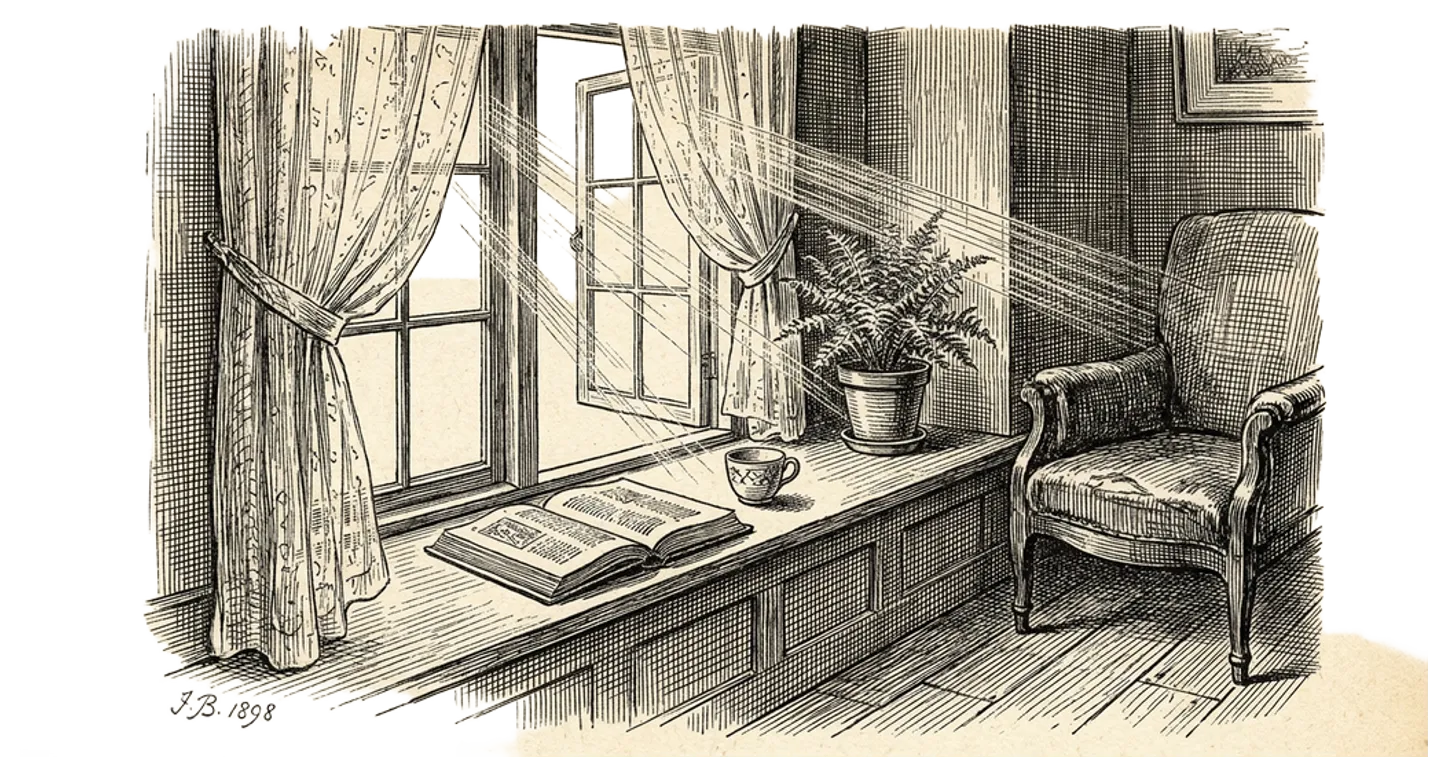
1. Pick the zone, not the room. A corner works. A single armchair works. A window seat, the end of a hallway, a spot on the floor with a cushion. What matters is that it feels separate — that crossing into it registers as crossing into it. A rug, a bookshelf turned as a divider, a specific chair you use for nothing else: any of these draws the line your brain needs.
2. Remove the devices, completely. This is step two only because step one had to come first. No TV, no laptop, no tablet, and the phone lives elsewhere. If the zone currently contains a screen, that screen has to go somewhere else or the zone has to move. There is no version of this that keeps the screen.
3. Make it comfortable before you make it pretty. A stiff, staged, photogenic space is one you won't use, and an unused analog room is just clutter with good lighting. Good light — warm, low, a real lamp rather than an overhead — and a seat you actually want to sit in will do more than any amount of styling. Comfort lowers the resistance to going there, and going there is the only thing that matters.
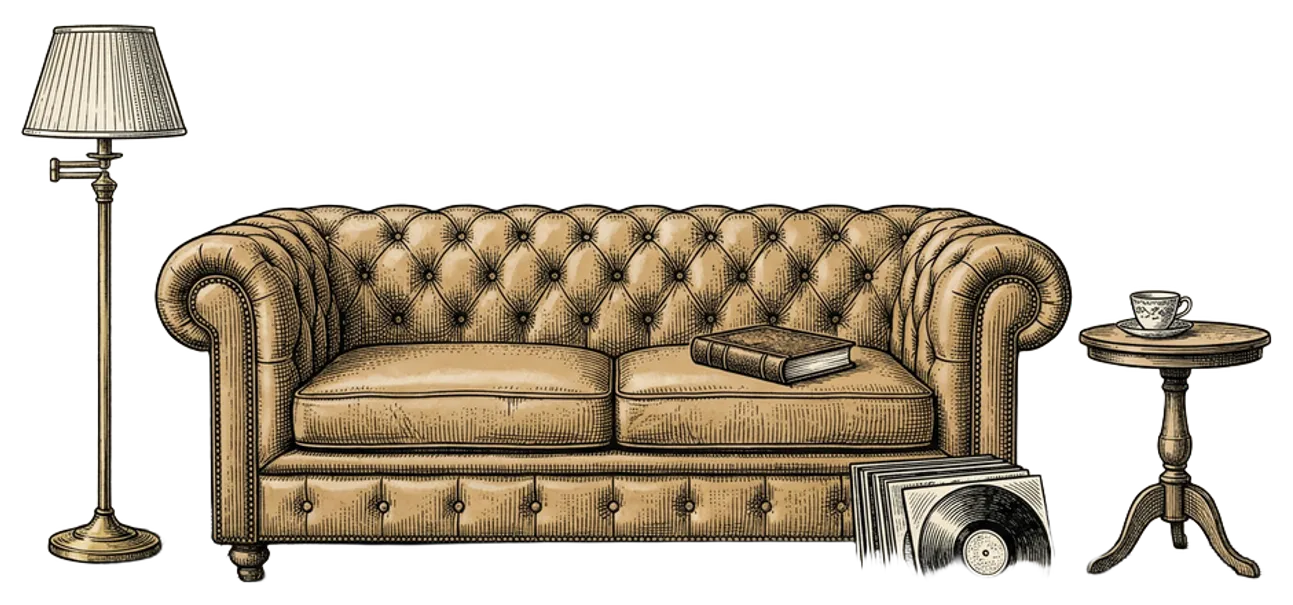
4. Stock it with one or two analog anchors, not ten. The trend pieces hand you a shopping list. Ignore most of it. Put in the one or two things you will genuinely reach for: the books you mean to read, or the turntable and records, or a notebook and a pen that's a pleasure to write with, or a film camera and the day's light. Pick by what you'll use, not by what photographs well. A room full of analog props you never touch is the same failure as the magazine set, just cozier.
5. Build a small ritual around entering it. The room works better with a cue: a cup of tea you make on the way in, a record you put on, a lamp you turn on that means now we are here. The ritual isn't decoration — it's the thing that turns "a corner of the room" into "the place I go," and that distinction is the whole difference between a habit and a piece of furniture.
That's the method. Notice there is nothing in it about the decade your aesthetic is borrowed from.
The honest counter-case
It would be against the spirit of this site to sell you the idea without the objections, so here they are.
It can be a way to buy your way out of a behavior problem. The retail version of the analog room invites you to purchase a solution — the rug, the lamp, the curated objects — to a problem that is fundamentally about a habit, not a room. You can assemble a perfect analog room and never sit in it, the way people buy running shoes instead of running. The room helps only insofar as you use it. If you suspect the appeal is mostly the shopping, that's worth being honest with yourself about; the digital detox ladder is cheaper and might be the thing you actually need.
It can become a designated reservation that lets the rest of the house off the hook. If the analog room is the one place phones aren't allowed, the implication is that everywhere else they are — including the dinner table and the bedroom, which are the two places the research most consistently says they shouldn't be. A single screen-free room can quietly license a fully screen-saturated home. The room is best understood as a beginning, not a quarantine.
The "luxury" framing excludes most people, and it doesn't need to. Casting the analog room as a status symbol — the new quiet-luxury flex — both misses the point and gatekeeps it. The point is attention, and attention is free. A cushion in a corner with no phone in reach delivers essentially the entire benefit. Anything past that is taste, and taste is allowed, but don't mistake the taste for the substance.
None of these are reasons not to make one. They're reasons to make the real thing — defined by the absence — rather than the marketed thing, defined by the props.
What a week with one actually looks like
Strip away the styling and the claims and here is what's left, which is plenty.
You come home. The phone goes in the basket by the door. Some evenings you go to the corner, turn on the lamp, and read for forty minutes, and it is the only forty minutes that day you did one thing at a time. Some evenings you put on a record and don't read, just listen, which you had honestly forgotten was a thing a person could do on purpose. Some evenings someone else is in the chair and you talk, and the conversation doesn't fork off to "let me just look that up." Some evenings you don't go in at all, and that's fine; the room is a tool, not a discipline.
What you'll notice after a couple of weeks isn't dramatic. It's that the evenings you used the room are the ones you remember. That's the whole return on it. It's not nothing — it might be most of what a quiet life is made of — but it's not transcendence either, and a site that promised you transcendence would be lying.
Related reading
- What a quieter home actually looks like — the analog room is one room; this is the same idea applied to the whole house, mostly by subtraction.
- How to do a digital detox (without being weird about it) — the behavioral companion to the spatial idea here.
- Why people are buying records again — on one of the better things to put in the room.
- Why paper still wins for thinking — on another.
- What film photography actually teaches you — and another, if your analog hours want a project.