
A few years ago, an article went around. You may remember it. The pen, it announced, is mightier than the keyboard. A pair of researchers had run a study showing that college students who took notes by hand outperformed those who typed on laptops. The finding was elegant. The implication was satisfying. Across the internet, in roughly four hundred lifestyle blogs, the headline became science proves handwriting is better for learning.
We want to write something we have not seen anyone write yet. We want to tell you what that study actually said, what happened when other researchers tried to replicate it, what they found instead, and what the honest evidence — once you assemble it — really tells us about writing on paper versus typing on a screen.
We are going to do this because the truth is more interesting than the cliché. The truth is also more useful, because it tells you when handwriting actually matters and when it doesn't, so you can stop apologizing for the laptop in the meetings where it works fine and stop pretending the paper planner is a wellness practice when it's really just a tool that helps you think.
The famous study
The study was Pam Mueller and Daniel Oppenheimer's "The Pen Is Mightier Than the Keyboard," published in Psychological Science in 2014. The researchers showed college students short, TED-style lecture videos and had them take notes — half on laptops with the internet disabled, half by hand. Afterwards the students answered questions about the lectures.
Two findings stood out. First, laptop users wrote a lot more, and a lot more of what they wrote was verbatim transcription of the speaker. In one of the experiments, laptop note-takers averaged about 549 words to longhand's 391, and laptop notes contained about three times as much verbatim language. Second — the famous one — longhand students did better on the conceptual questions. Not the simple "what did the speaker say" questions, but the harder "what does this idea imply" questions.
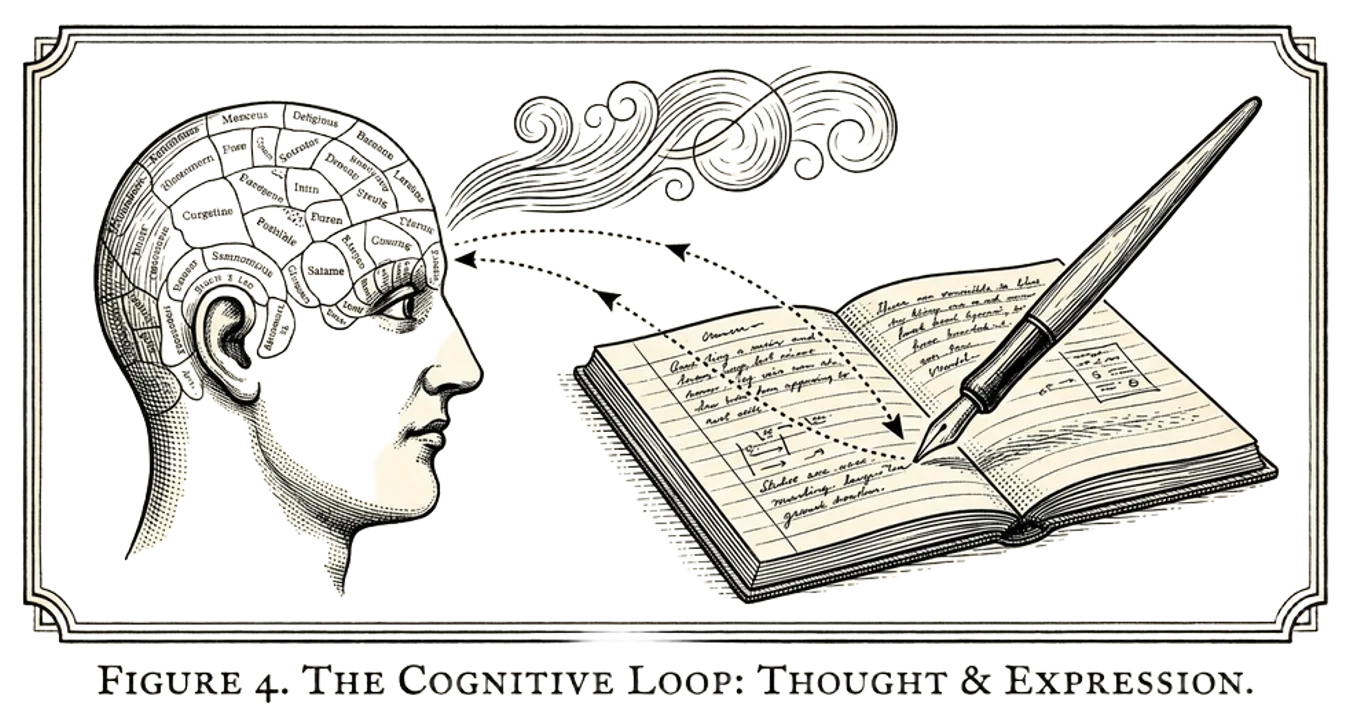
The authors proposed a tidy mechanism. Typists, they argued, fall into mindless transcription. The keyboard is fast enough that you can simply copy, and copying requires no thinking. Longhand is slow enough that you have to choose what's worth writing down, which means you have to think about what the speaker is actually saying. The slowness was not a bug; it was the entire point.
It was a clean story. It traveled.
What did not travel — what almost never travels in the popular telling of a scientific finding — was what happened next.
Two failed replications, in plain language
The way you find out whether a study's conclusions are robust is to do the study again. This is called replication. It is how science is supposed to work, and a lot of psychology research from the 2000s and 2010s has not held up under it.
In 2019, Kevin Morehead and his colleagues at Kent State published a careful replication of Mueller and Oppenheimer in Educational Psychology Review. They did exactly what the original study did, but with more students, more conditions, and a longer delay. They added a condition where students just watched and took no notes at all.
They could not reproduce the original finding. Longhand note-takers and laptop note-takers performed about the same. So did the students who took no notes at all. In one of their experiments, longhand actually did better on factual questions — the reverse of the original headline, which had been about conceptual questions.
Then in 2021, Heather Urry at Tufts published a direct replication in the same journal that had published the original. Psychological Science. Her replication was co-authored by her entire experimental-psychology class — about eighty undergraduates, an exemplary way to do replication science. They reproduced the behavior of the original study exactly: yes, typists wrote more, and yes, typists wrote more verbatim text. But the learning difference vanished. The longhand students did no better on conceptual recall than the laptop students. They did a small mini-meta-analysis of eight similar studies and concluded that, taken together, the writing-versus-typing effect on immediate learning is not statistically significant.
So where does this leave us? The famous study is real. It exists. You can read it. But its main claim — that handwriting beats typing for adult learning — did not survive scrutiny. The behavioral difference is robust: typists transcribe more, longhand writers paraphrase more. The consequence that was supposed to follow from that behavioral difference — better understanding — has not been demonstrated reliably.
We are spending real time on this because the original study is the cited backbone of approximately every article on the internet that claims handwriting is "scientifically proven" to be better for learning. And the claim, as commonly stated, is not supported by the evidence as it stands today. The honest version of the science is not as flattering to a paper-and-fountain-pen lifestyle as a magazine article would like it to be — but it is more interesting, and it is more useful.
Where the evidence actually is strong
Now, having taken the most famous claim apart, we can put something better in its place. The evidence on paper and handwriting is strongest in three places, and each is worth knowing on its own terms.
Children learning to read. This is the most defensible neuroscience in the entire topic. In 2012, Karin James at Indiana University published an fMRI study in Trends in Neuroscience and Education showing that pre-literate children who learned letters by handwriting them — not by typing or tracing — were the only group whose brains, weeks later, activated a recognizable "reading circuit" when shown those letters. The proposed mechanism: forming a letter by hand produces wobbly, variable output. The brain, learning the letter, has to extract what's essential about an "A" across many imperfect attempts of its own. Typing, by contrast, produces a perfect identical "A" every time, which gives the brain less to work with.
Marieke Longcamp's group in France has shown related effects in adults learning unfamiliar characters: people who learned the characters by hand recognized them better afterwards than people who learned by typing, and brain regions associated with motor planning activated even when they were just looking at the letters they had previously written.
The takeaway from this body of work is narrower than the popular telling but more solid: forming letters by hand is part of how a brain learns to read. This is why thoughtful early-childhood education and occupational therapists care about handwriting. It is also why states that quietly dropped cursive instruction during the Common Core era are quietly putting it back — California reinstated a cursive requirement for grades one through six in 2024, with several other states following.
Reading on paper versus reading on a screen. A 2018 meta-analysis by Pablo Delgado and colleagues at the University of Valencia pulled together fifty-four studies of paper-versus-screen reading, covering about 171,000 participants. They found a small but consistent paper advantage — roughly the size statisticians call "modest" — but with two important wrinkles. First, the advantage shows up reliably only for expository text — the dense, informational kind. Narrative fiction reads about the same on either medium. Second, the advantage gets bigger under time pressure: when readers have to absorb information quickly, paper helps more.
A subtler finding: the gap has not closed for "digital natives." Younger readers, who grew up with screens, do not show better screen reading than older readers do. The effect appears to be about the medium, not the reader.
So if you read a long, important article on your phone while half-distracted, you are absorbing less than if you read it on paper. Not catastrophically less. Modestly less. But consistently less.
Distraction in the classroom. This one is technically about laptops, not handwriting, but it matters because it is often what people mean when they argue against laptops in lectures. A 2013 study by Faria Sana and colleagues in Computers & Education found that students who multitasked on laptops during class scored about eleven percentage points lower than students who did not. The more striking finding: students who were merely sitting in view of a multitasking peer's laptop scored about seventeen points lower than students who were not. The screen of the person in front of you, displaying their unrelated email, is enough to hurt your learning.
This is the strongest, least contested case against laptops in lectures. But notice what it is and is not. It is a case against distraction. It is not a case for handwriting per se. A disciplined typist on a laptop with the internet disabled would presumably do fine.
What about journaling, and the mental health claims?
There is a separate, large body of research — going back to James Pennebaker's work at the University of Texas in the 1980s — on what happens when people write about emotionally difficult experiences for fifteen or twenty minutes a day over several days. The headline finding is that this kind of "expressive writing" produces small but real improvements in physical and mental health: lower stress markers, fewer doctor visits, better mood.
Two things to know about this literature. First, the effect is small. Across the hundreds of studies, the average effect size is roughly what statisticians call "small" — meaningful, but modest. Some rigorous meta-analyses of randomized trials have failed to find significant effects at all. Second, and crucially: this research generally does not compare handwriting to typing. The benefit, where it exists, appears to come from the act of disclosure and the structured reflection — putting words to a difficult experience. Whether you do that with a pen or a keyboard has rarely been tested directly.
When lifestyle media writes about "the magic of journaling," it almost always conflates these two things — the (modest) benefits of expressive writing, and the (unestablished) benefits of doing it on paper. Be wary of articles that don't make the distinction.
The one viral study you've probably seen, handled honestly
In early 2024, a study out of Norway started showing up everywhere. Researchers at NTNU put EEG sensors on university students, had them write words on a touchscreen and type words on a keyboard, and found that handwriting produced more "widespread brain connectivity." The press release — and ninety percent of the resulting coverage — framed this as proof that handwriting is better for learning.
The study did not measure any learning. The participants wrote words they already knew. There was no quiz. There was no recall test. There was no learning task at all. The researchers measured brain activity during the writing, observed differences, and inferred that those differences would be good for learning if learning had been measured.
A formal published critique in early 2025, by Sylvain Pinet and Marieke Longcamp — the latter being one of the most respected researchers in this entire field, and someone who is generally sympathetic to the case for handwriting — laid out the problems clearly. The typing condition required students to use only their right index finger and gave them no visual feedback as they typed, an artificial setup that may have suppressed normal typing-related brain activity. The connectivity patterns the researchers observed are not actually known to be especially "learning-favorable." And the leap from a lab study with university students performing a non-learning task to recommendations about how children should be taught in classrooms was, as the critique put it, "slippery at best."
The original study had been viewed eighty-five thousand times and covered by a hundred and seventy-nine news outlets. The critique, as of this writing, has been viewed a small fraction of that. This is how the loud version of a finding usually outpaces the careful version. It's worth noticing when it happens to you.
So what does the honest version say?
If you have read this far you may be wondering whether we are about to argue that paper doesn't matter and you should go back to your laptop. We are not.
We are arguing that the case for paper has been made in the wrong way, and that the right way is better. Here is the right way.
Paper is not a magic productivity supplement. It does not, on the evidence we have, automatically make you learn better or think better. What it does is more useful than that: it changes the kind of attention you bring to what you are doing. It is slower. It cannot multitask. It does not ping. It does not offer you a hyperlink to a different topic three paragraphs in. It does not save what you write to a server owned by a company whose business depends on knowing what you write.
These are not small things. They are the things that make paper good for certain kinds of thinking — the slow kinds, the generative kinds, the kinds where you don't yet know what you are going to say and you need a medium that doesn't punish you for not knowing.
For taking quick reference notes you'll search later, a laptop is fine — better, actually, because it's searchable. For capturing a meeting where someone is talking at speed and you need to keep up, a laptop is fine. For students with motor or visual or processing disabilities for whom handwriting is genuinely painful or impossible, a laptop is more than fine — it is the right tool, and any teacher who insists otherwise is being a fool about it.
For working out what you actually think — for sitting with a problem and writing your way toward an answer — paper is, in our experience and in the experience of nearly every writer we know, better. For planning a week or a quarter where you want the planning itself to feel real rather than provisional, paper is better. For reading a difficult piece of writing closely, on paper. For drafting something hard.
The research doesn't prove this. The research is mostly silent on it, because most of the research has been about either children learning letters or college students recalling lectures, and "working out what you think" is much harder to measure. But the absence of proof is not the absence of evidence. The behavioral findings that have replicated — that typing produces more verbatim transcription, that paper reading favors slower and deeper engagement, that laptops in shared spaces produce distraction even for people who aren't using them — all point in a consistent direction.
How to use this, practically
Three small things you can do today, in order of how cheap they are:
One. Read the next long, important thing on paper instead of on your phone. Print it out, if it's a web article. Notice whether you remember more of it the next day. (You probably will, modestly.)
Two. Buy a small paper notebook — any kind, this is not the moment to overthink it — and use it for one specific thinking job that you currently do on a laptop. Drafting an email you're dreading. Working out what you think about a decision. Planning your week. Just that one job. Don't try to migrate your whole life to paper; that's the kind of all-or-nothing detox we've written against in our piece on doing a digital detox without being weird about it.
Three. If the small notebook works for that one job, consider a planner. We have an honest comparison of the ones we think are good — including the strong argument that the best planner is the one you already own. The point is not to acquire the right object. The point is to give yourself a tool that does one thing and then stops, in a part of your life where everything else is trying to do twenty things at once.
That's the case. Paper is not magic. It is also not nostalgia. It is a different kind of attention, available cheaply, defended by a real if modest body of evidence, and increasingly valuable in proportion to how loud everything else has become.
We use it. We think you'll find, if you do too, that the value isn't in any one finding from any one study. It's in the small experience of writing slowly, with one tool, on something that doesn't listen back.