

Borrow first. Then KEH. Then everything else.
We said it in our getting-started guide and we'll say it again: your first film camera should be borrowed or bought used. Not because new cameras are bad, but because you don't yet know what you want from a camera — and spending $500 to find out is expensive when $100 would teach you the same things.
KEH.com sells tested, graded used cameras with a return policy. They are not an affiliate partner. We link to them because they're trustworthy, not because we earn from it. That said, for new film and accessories, we do have an affiliate relationship with B&H Photo — disclosed wherever we link to them.
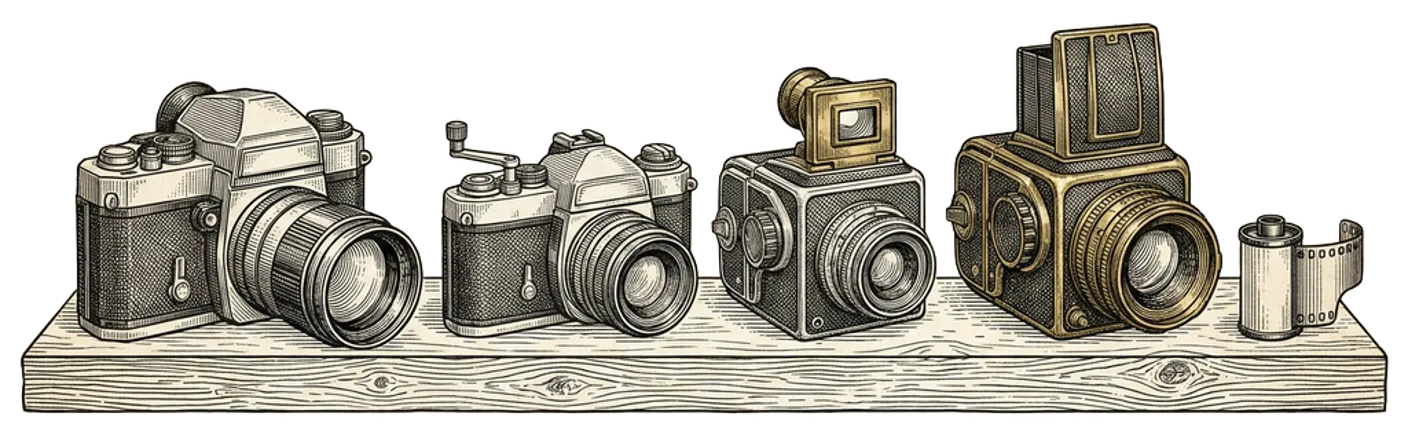
Here are four cameras that teach beginners well, honestly compared.
Pentax K1000 — Used, ~$100-150
The camera most often recommended in "learn photography" courses for forty years, and the recommendation is earned.
What it teaches you: Full manual exposure. You set the aperture, you set the shutter speed, you read the needle meter in the viewfinder. There is no automatic mode. Every frame is a decision you made.
What it does well: Indestructible build (metal body, mechanical shutter). K-mount lenses are cheap and plentiful. The meter is simple — a needle that moves up or down. It works without batteries for everything except the meter.
What it doesn't teach you: Anything about aperture-priority shooting. It won't help you learn to work quickly — it's slow by design. No depth-of-field preview on most models.
Who it's for: Someone who wants to learn exposure fundamentals from the ground up. Patient people. People who like the feeling of mechanical things.
Who should skip it: Anyone who wants to shoot fast (street photography, kids, events). Anyone who gets frustrated without a safety net. Anyone with hand pain — the K1000 is heavy and the advance lever has resistance.
Condition notes: At $100-150, expect cosmetic wear. Check the meter (have the seller test it or buy from KEH where it's guaranteed). Avoid any with a sticky shutter or a dented filter ring.
Canon AE-1 — Used, ~$150-250
The best-selling SLR of the late 1970s. More Canon AE-1s exist in the world than any other film SLR. This means parts, repair techs, and lenses are everywhere.
What it teaches you: Shutter-priority automatic exposure — you pick the shutter speed, the camera picks the aperture. This is a halfway house between full manual and full auto. You learn to think about motion (fast shutter = freeze, slow shutter = blur) while the camera handles brightness.
What it does well: FD-mount lenses are optically excellent and still cheap (the 50mm f/1.4 is one of the best normal lenses ever made for under $80). The body is lighter than the K1000. The viewfinder is bright.
What it doesn't teach you: Aperture control, unless you switch to manual mode (which the AE-1 does support, just less intuitively). Doesn't teach you to slow down the way a fully manual camera does.
Who it's for: Someone who wants to learn but also wants usable photos from week one. Someone who plans to shoot in mixed-light situations. Someone who values a large, cheap lens ecosystem.
Who should skip it: Anyone who wants to learn full manual fundamentals first (get the K1000). Also: the AE-1 has a known issue — the "Canon squeal" — where the mirror dampener degrades and the shutter makes a high-pitched sound. It's repairable (~$50-80) but annoying. Ask about it before buying.
Condition notes: Pay attention to the shutter sound. A clean, decisive "click-thwack" is healthy. A squeal or screech means the dampener needs replacement. Light seals are often degraded at this age — budget $15-20 for a reseal kit or have KEH do it.
Olympus OM-10 — Used, ~$80-150
The smallest and lightest of the group. The Olympus OM system was designed around compactness — the bodies are tiny for SLRs, the lenses are small, and the whole kit fits in a bag you'd actually carry.
What it teaches you: Aperture-priority automatic exposure — you pick the aperture (controlling depth of field), the camera picks the shutter speed. This is arguably the most useful automatic mode for learning, because aperture is the creative control in most situations.
What it does well: Incredibly compact body. Zuiko lenses are sharp and contrasty — the 50mm f/1.8 is a gem. Quiet shutter. Bright viewfinder.
What it doesn't teach you: Manual exposure — the OM-10 doesn't have a manual mode unless you buy a separate manual adapter that plugs into the body. This is the camera's main limitation for learning.
Who it's for: Someone who wants to shoot a lot without thinking about exposure, while learning composition and aperture control. Someone who wants a small, light kit for travel or daily carry. Someone who values quiet operation.
Who should skip it: Anyone who wants full manual control from day one. Anyone who wants to learn the complete exposure triangle simultaneously.
Condition notes: Check that the aperture-priority mode responds correctly to light changes. The OM-10 uses LR44 batteries (cheap, available everywhere). Light seal degradation is common — factor in a reseal.
Pentax 17 — New, ~$500
The only currently-manufactured film camera in this price bracket. Released in 2024 by Ricoh (who owns Pentax), it's a half-frame 35mm camera — meaning it shoots two smaller frames per standard 35mm frame, giving you 72 exposures per roll instead of 36.
What it teaches you: Composition in a vertical format (half-frame cameras shoot portrait-oriented frames by default). How to be less precious with frames — at 72 shots per roll, the cost-per-frame pressure drops significantly. Zone focusing (it's not an SLR — you estimate distance rather than focusing through the lens).
What it does well: New, under warranty, reliable. Beautiful build quality. Zone focus is fast — point and shoot. The half-frame format means each roll lasts twice as long, which is economical.
What it doesn't teach you: SLR technique. Manual focus through a viewfinder. The mechanical relationship between shutter and aperture. It's closer to a point-and-shoot in handling, which is fine but different.
Who it's for: Someone who specifically wants a new camera (no used-market anxiety, warranty, modern film-speed detection). Someone who likes the half-frame aesthetic. Someone who already knows they'll shoot a lot and wants to cut film costs in half.
Who should skip it: Almost everyone in this article. At $500 for a camera that doesn't teach SLR fundamentals, you're paying a premium for the novelty of "new" and the half-frame format. Unless those specifically appeal to you, the $100-150 used options above are better teachers and better values.
Available from B&H Photo. Disclosure: affiliate link.
Don't buy
- Don't buy until you've shot at least one roll on a borrowed camera. The tactile experience matters and you can't evaluate it from reviews.
- Don't buy from eBay sellers with no return policy. Film cameras are mechanical — things break invisibly.
- Don't buy a camera "for the aesthetic." If you want an object to display on a shelf, buy a broken one for $20. If you want to make photographs, buy a working one and use it.
- Don't buy a Leica. Not now, probably not ever, definitely not as a beginner. You will spend $2,000-5,000 and learn nothing a $100 Pentax wouldn't teach you faster.
What we returned
We bought a Canon AE-1 Program (the AE-1's fancier sibling) from a non-specialist eBay seller. The meter was inaccurate by two stops — every frame would have been overexposed. The seller hadn't tested it. We returned it and bought from KEH instead. Lesson: buy from specialists who test their inventory.
What we'd actually buy
For a true beginner who wants to learn: the Pentax K1000 from KEH in "bargain" grade (~$100). It's the hardest to use and the best teacher. Pair it with whatever 50mm K-mount lens is cheapest ($30-50 used).
For someone who wants usable photos quickly while still learning: the Canon AE-1 with the 50mm f/1.8 FD lens. More versatile, lighter, faster to work with.
For someone who will carry it every day: the Olympus OM-10. It's the one you'll actually take with you because it's small enough to not be a burden.