
If you read about film photography online, you will encounter, very quickly, a confident sentence in roughly this shape: film teaches you to see.
It's a good sentence. We have written it ourselves, in earlier drafts of this piece, and crossed it out, and rewritten it, and crossed it out again. The reason we kept stopping is that the sentence is not, by itself, true. Film does not teach you anything. A roll of Portra 400, sitting in its little black canister, has no pedagogical intent. The people who write that film teaches you to see are smuggling in a different claim — that the constraints of shooting film teach you to see — and then attributing the lesson to the medium rather than to the constraints.
This matters because once you say what film actually is — a medium that costs roughly a dollar every time you press the shutter, and which makes you wait a week to find out whether what you took looks like anything — you have said most of what's worth saying. The rest is just paying attention to what those two facts do to a photographer.
That's what we want to do here. We want to tell you what shooting film actually does to the person doing it, with the research that supports each piece of the claim, and the honest concessions where the claim breaks down. By the end you'll know whether picking up a film camera is worth your time. (For many people, it is. For some people, it isn't.) And you'll know why the lesson isn't really about film at all.
Yes, the revival is real
A quick orientation, because the rest depends on it being true.
Film photography is back. Not as a mass-market technology — that's gone forever — but as a durable, growing, surprisingly young subculture. Eastman Kodak has said that production of still film more than doubled between 2015 and 2019, and the company's vice president of film manufacturing told a Rochester podcast in 2022 that what had been a three-shift, five-day operation was now running twenty-four hours a day, seven days a week, with over three hundred new hires. Harman, the UK manufacturer behind the Ilford brand, announced in 2024 a multi-million-pound investment to more than double cassette output — the first new film-converting machines built since the 1990s.
In June 2024, Ricoh launched the Pentax 17, a $499.95 half-frame 35mm camera — the first all-new film camera from a major manufacturer in roughly two decades. The product was so explicitly aimed at people in their teens and twenties that Ricoh's lead executive on the project said, in an interview, "A film camera is not something nostalgic for our target customers in their teens and 20s. In fact, it is something completely new." Initial demand outpaced the company's manufacturing capacity. Time named it one of the best inventions of 2025.
In the used market, MPB — the largest secondhand camera platform in the world — has reported doubling its customer base over three years, recirculating more than half a million cameras, lenses, and accessories in a single year. Fujifilm's instant-film line, Instax, passed 100 million cumulative units sold in early 2025; Fujifilm executives have publicly called it a "goldmine."
There are caveats inside these numbers. Most of the figures come from the companies themselves and should be read with that in mind. The Pentax 17's lead designer has since left the company and the future of the Pentax film line is, as of this writing, ambiguous. Film prices are up across the board — Kodak Alaris raised consumer film prices about 8% in January 2025 — which is a real accessibility problem we'll come back to.
But the direction is clear. Film, the format that was supposed to be dead by 2010, is the largest analog photography market it's been in decades. And the engine of that growth is mostly people who weren't alive the first time around.
What film actually does
Now to the part that actually matters. What does shooting film do — to your photography, to your attention, to the way you see?
Two things, mechanically. It costs money every time you press the shutter, and it makes you wait to find out whether the picture worked.
The first is straightforward. A 36-exposure roll of color film, plus development, plus scanning, runs roughly twenty to forty dollars in 2025 — call it about a dollar per frame, give or take. That number changes everything about how you behave with the camera. Press the shutter on a digital camera and the worst thing that happens is a wasted second. Press the shutter on a film camera and you have just spent a dollar on what you hope is a photograph. You raise the camera differently. You wait for the light. You move your feet. You decide, in advance, whether what you are looking at is worth a frame.
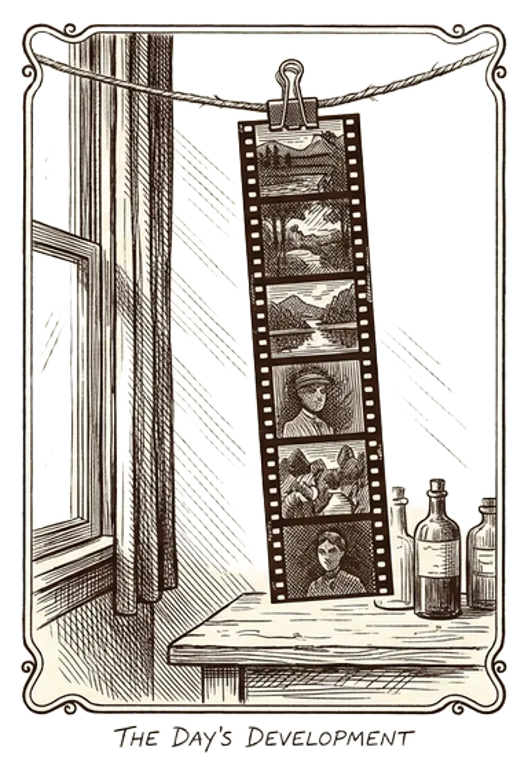
The second mechanism is less obvious and probably more important. With a digital camera, you take a photograph and look at it instantly on the back of the camera. You can adjust. You can shoot again. You can show it to the person you photographed. You can post it before you've left the place where you took it. With a film camera, you take the photograph and then nothing happens for a week, or two weeks, or a month. The roll has to fill up. You have to find time to drop it at the lab or mail it in. The lab has to process it. Someone scans it. Eventually a download link appears in your email.
The delay is not a bug of the medium. It is the medium. And it does specific things to the photographer that nothing else does.
The research, briefly and honestly
The reason we know these two mechanisms matter is that they are well-studied, just not in the context of film specifically.
The first mechanism — constraint — has a real research base going back to the 1990s. Patricia Stokes, a psychologist at Barnard College, wrote a 2006 book called Creativity from Constraints whose central argument is that creative work is generated not by unbounded freedom but by self-imposed limits that block easy solutions and force the search for new ones. Stokes's example is Monet repeatedly painting variations of the same subject — haystacks, the Rouen Cathedral, the lily pond — each round constrained by the previous one. A 2017 study by Catrinel Haught-Tromp at Rider University, named in the literature after Dr. Seuss writing Green Eggs and Ham on a 50-word vocabulary bet, showed that participants asked to write rhymed couplets that had to include a specific noun produced more creative rhymes than participants given no constraint at all. A 2019 review in the Journal of Management synthesized the broader literature and proposed an inverted-U relationship: a moderate amount of constraint produces the most creative work; too little produces complacency, and too much produces fixation and surrender.
The second mechanism — attention — has its own research backbone, anchored by a 2014 study from Linda Henkel at Fairfield University called "Point-and-Shoot Memories." Henkel found that museum-goers who photographed objects on a guided tour remembered fewer objects, fewer details about each object, and fewer object locations than museum-goers who simply observed them. The effect — now known as the photo-taking-impairment effect — has been replicated several times, including by Soares and Storm in 2018, who showed it persists even when the photos are immediately deleted. The mechanism, it turns out, is not that we offload memory to the camera. It is that the act of pulling up a camera disengages our attention from the thing we're looking at.
Henkel put it bluntly in interviews: "People so often whip out their cameras almost mindlessly to capture a moment, to the point that they are missing what is happening right in front of them."
So: there is real science showing that constraint promotes creative output, and real science showing that mindless photography degrades the encoding of an experience. Both of those findings line up with the experience of shooting film. And — this is the important honesty move — neither of them is about film specifically.
Where the argument breaks down (we have to do this part)
Here is the obvious objection. If the benefit of film is constraint, you can choose those constraints on any digital camera. One lens. One memory card with a small capacity. Manual mode only. A rule that you won't look at the back of the camera until you get home. Treat each shutter press as if it cost a dollar.
This is true. A disciplined photographer on a digital camera, who has internalized these rules, will get most of the benefits of shooting film. We have known photographers who do exactly this and produce work as deliberate, as composed, and as memorable as anyone shooting Portra.
What film does, that self-imposed digital constraint cannot, is make the discipline involuntary. You don't have to remember the rules. You don't have to fight the impulse to chimp the LCD because there is no LCD. You don't have to limit your frames because there are only thirty-six of them. You don't have to wait to post the photo because the photo doesn't exist yet. The medium does the work the willpower would otherwise have to do — and willpower, as everyone who has ever tried to maintain a habit knows, is the resource that runs out.
This is the same argument we made about paper rather than apps for thinking, and about records rather than streaming for music, and in a different shape about phones for daily life. The case for an older medium is rarely that the medium is technically superior. The case is that the medium hard-codes a discipline you would otherwise have to manufacture for yourself, and that the manufacturing is the part that fails.
The other important honesty move is that the attention research isn't as one-sided as the popular telling suggests. A 2017 study by Alixandra Barasch and colleagues, published in Psychological Science, found that participants who took photographs during an experience actually had better visual recognition of what they had seen — and even of things they hadn't directly photographed — than participants who didn't take photographs at all. A related 2016 study by Kristin Diehl and colleagues, in the Journal of Personality and Social Psychology, found that taking photos can increase enjoyment of an experience.
The picture that emerges, putting all the research together, is more careful than "cameras ruin memory." It looks more like: mindless, high-volume capture degrades attention and memory. Deliberate, selective photography — the kind a film camera forces and a digital camera permits — actually sharpens visual perception. Which means the active ingredient really is the behavior, not the medium. Film just makes the behavior easier to maintain.
What film teaches, then, stated carefully
A roll of film costs about a dollar a frame and a week of your life to develop. That is not a defect of the medium. That is the medium. And those two costs, taken together, teach you four things that are genuinely worth learning.
They teach you to see before you shoot. When a frame costs a dollar and you have thirty-six of them, you stop snapping and start looking. You wait for light. You move three feet to the left. You decide whether you actually want this composition or just thought you did. The photographer Henri Cartier-Bresson famously described "the decisive moment" as "the simultaneous recognition, in a fraction of a second, of the significance of an event as well as of a precise organization of forms which give that event its proper expression." Cartier-Bresson's surviving contact sheets show, by the way, that he often shot five or ten frames of a scene to get the one — so the romantic "one perfect shot" reading of the decisive moment is partly a myth. But the underlying point holds: a finite roll trains your eye to recognize the picture before you take it, because you cannot afford to do it the other way around.
They teach you to live in the moment you're photographing. This is the Henkel finding, made personal. The film photographer, after pressing the shutter, has nothing to do with the picture for at least a week. Cannot post it. Cannot edit it. Cannot show anyone. Cannot let the result alter the next picture you're about to take. The week of forced patience is — empirically, in the research — the thing that protects the encoding of the moment. You experience the day, then the day disappears, and then weeks later you find out what you saw.
They teach you to commit. A roll of film is thirty-six exposures of one ISO, one stock, one set of decisions. You cannot change in the middle. You picked Portra 400 this morning, you are shooting Portra 400 all day, and the limits of Portra 400 are your limits. This is the constraint research playing out in practice — the inverted U from the Journal of Management paper. You don't want zero constraint and you don't want infinite constraint; you want one good constraint you accepted at the start of the day and will live with until the roll is full.
They teach you to make peace with what you missed. This is the lesson nobody writes about because it is uncomfortable. Some rolls come back and the picture you knew you got isn't there. The exposure was wrong. The focus was off. The frame was empty. You cannot do it again because the moment is gone, and the camera did not tell you while there was still time to fix it. This is — and we are aware of how this sounds — useful. The lesson is that most of life works this way. The digital habit of trying again until it's right is an artificial superpower that doesn't extend beyond the camera. Film returns photography to the human condition.
What film does not teach you
A short list, for honesty.
It does not teach you that film captures reality more truthfully than digital. It doesn't. Susan Sontag, in On Photography, observed that "photographs are as much an interpretation of the world as paintings and drawings are." Film has its own look — the grain, the way the highlights roll off, the muted greens of certain stocks — but those are aesthetic preferences, not testimony. Most modern film photography is scanned to digital files anyway and processed in software before you see it.
It does not teach you that you should refuse to shoot digital. Most professional photographers we know who shoot film also shoot digital, often on the same day, often for different parts of the same job. The right tool depends on the work. A wedding photographer shooting only film on a once-in-a-lifetime event would be making a values claim, not a technical one.
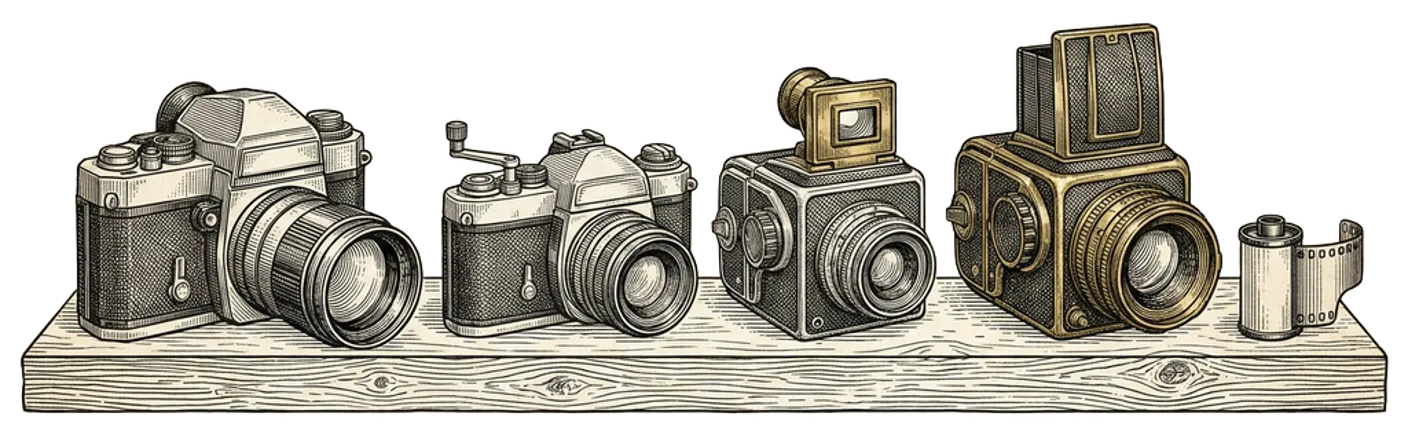
It does not teach you to be precious about your camera. The best film camera for most people is a used Pentax K1000, Canon AE-1, or Olympus OM-10 from KEH for under two hundred dollars. We have an honest comparison of beginner film cameras elsewhere on the site. The Pentax 17 is wonderful and we recommend it, but the lesson of film is the constraint, not the object.
And it does not teach you anything if you don't actually shoot it. Buying a film camera that sits on a shelf is the same kind of unforced error as buying a record you never play. The medium only works on a photographer who picks it up.
A few last honest things
Film is expensive and getting more so. A roll of Portra in 2025 costs around fifteen to twenty dollars before processing. The mail-in lab adds another ten to twenty. If you shoot a roll a week, you're spending a thousand to two thousand dollars a year on film alone. This is a real accessibility problem, and the people who romanticize the medium without acknowledging the cost should be ignored. If you can't afford it, shoot one roll a month, or shoot expired bulk-loaded film, or shoot black-and-white you develop yourself. The lessons are the same.
Film has an environmental cost — processing chemicals, single-use plastic canisters, the carbon of shipping rolls to labs. It's small per roll and large in aggregate, and there's no honest way to claim a moral high ground over digital on this dimension.
And film is fragile. Rolls get lost. Labs make mistakes. A heat-soaked car ruins a vacation's worth of shots. The medium has fewer guarantees than digital and you should make peace with that before you commit to it.
That said. If, after reading all of the concessions, you still feel pulled toward picking up a film camera — the way some readers will, who have read this far precisely because they wanted to be talked out of it and weren't — then go ahead. Buy a used SLR for under two hundred dollars. Get a single roll of Portra 400. Shoot it slowly. Don't look at the back of the camera, because there is no back of the camera. Send it to a lab. Wait. Try to forget what you photographed. See what comes back.
You may find that what comes back is not your best photography. You may find that the act of waiting changes how you take the next picture more than any technique ever did. You may find, eventually, that you are walking around looking at things in a different way — not because the camera taught you, but because the discipline of using it left a mark on the looking.
That is the actual lesson. It is small. It is real. It is — though we have spent twenty-five hundred words being careful about this — worth most of what it costs.