
Borrow a camera first
Somewhere in your life — a parent's closet, a friend's shelf, a neighbor's garage — there is a film camera that nobody is using. Ask to borrow it. This costs nothing, commits you to nothing, and gets a camera in your hands this week instead of next month after you've researched yourself into paralysis.
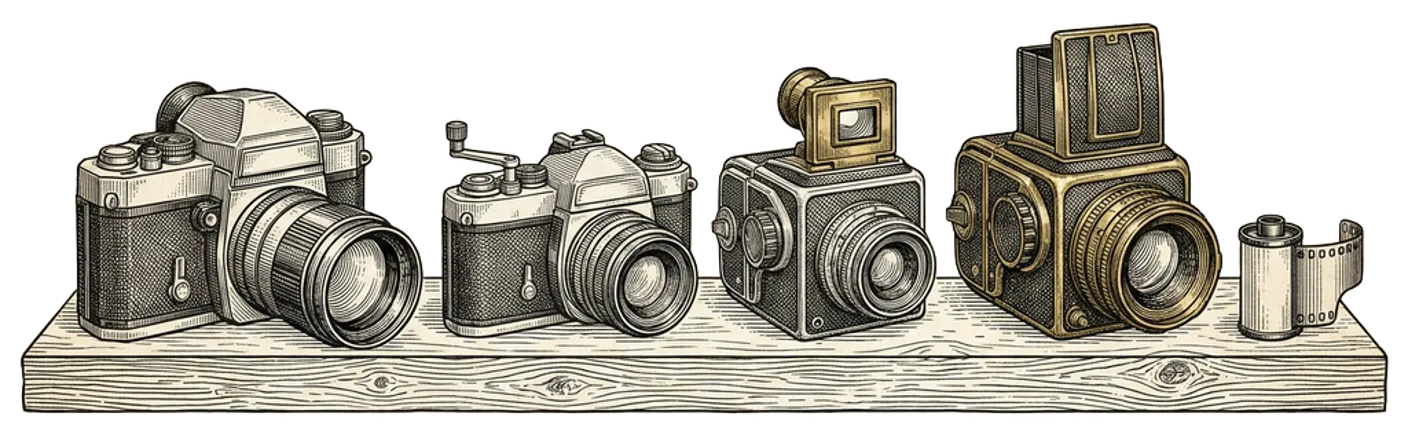
If nobody you know has one: buy used. KEH, a reputable used camera dealer, sells tested film cameras starting around $50-80. A Canon AE-1, a Pentax K1000, a Minolta X-700, an Olympus OM-1 — any of these is more camera than you need for your first two years. They are all good. The differences between them do not matter yet.
Do not buy new equipment until you have shot ten rolls of film. That is not a metaphor. It is a rule. Ten rolls — 360 exposures — is enough to learn whether this is a hobby you love or a hobby you like the idea of. The answer matters before you spend more money.
Your first roll
Buy a single roll of Kodak Gold 200 or Fuji 200. These are cheap (around $8-10 per roll), widely available, and extremely forgiving. They handle daylight well, they handle shade well, they even handle bad indoor light better than you'd expect. Do not start with black-and-white. Do not start with fancy film. Start with the reliable, unglamorous stuff.
Load the camera. If you don't know how, the manual is online (every film camera manual ever made is on the internet for free). Or watch a single two-minute video. It's not complicated.
Now shoot the whole roll on whatever you find interesting. Don't try to make art. Don't plan compositions. Just photograph things that catch your eye — the light in your kitchen, your dog, the way a building looks at 4pm, your coffee cup, your friend laughing. Burn through the roll in a week. Speed matters here because deliberation at this stage is the enemy.
Getting it developed
Take the roll to a local photo lab or a drugstore that still processes film. If no local option exists, mail it to a lab (The Darkroom, Indie Film Lab, and Richard Photo Lab all accept mail orders). Ask for develop and scan — you'll get digital files back that you can view on your phone or computer.
Cost: around $12-18 for develop and scan. So your total investment for the first roll is roughly $20-30 (film plus development), assuming you borrowed or bought the camera used.
When you get the scans back
Look at every frame. Don't delete anything. Notice which ones you like — not which ones are technically perfect (none of them will be), but which ones you like. Which ones have something in them that feels like what you saw.
Some will be blurry. Some will be badly exposed. Some will be boring. That is the whole point. Film teaches you things that digital photography cannot teach because it removes the instant feedback loop. You make a choice, you commit to it, you don't see the result for days. That gap between intention and result is where learning lives.
What film teaches you about attention
This is the part we care about most, and the part that connects film photography to everything else on this site.
Digital photography is free and instant, which means it encourages you to shoot without seeing. You can take 400 photos at a birthday party and look at none of them. You can photograph your food to post it, not to remember it. The camera becomes a device for recording without experiencing.
Film has 36 frames. Each one costs you about 75 cents when you factor in development. That constraint — a small one, a gentle one — changes how you see. You start looking before you lift the camera. You start deciding what matters before you press the shutter. You learn to see light, to see composition, to notice the things around you with more care.
That attentiveness doesn't stay in the camera. It leaks into the rest of your life. You start seeing better everywhere — the way shadows fall in your home, the colors of a late afternoon, the expression on someone's face that lasts half a second. Film is a practice in noticing, and noticing is a practice in being present.
You don't need film to learn this. But film teaches it without lectures.
Once you're hooked (after ten rolls)
If you've shot ten rolls and you still love it, now you can buy with confidence:
Film: Buy in bulk. Five-packs from B&H Photo bring the per-roll cost down. Try Kodak Portra 400 for portraits and warm tones, or Ilford HP5 Plus if you want to try black-and-white. Disclosure: we have an affiliate relationship with B&H Photo. If you buy through our link, we earn a small commission at no extra cost.
A second lens: If your camera accepts interchangeable lenses, a 50mm f/1.8 (any brand) will change what you can do in low light and how you see depth. Buy it used. $50-100.
A scanner: If you want to develop at home eventually, a Plustek 8100 is the standard starter scanner. But that's an advanced-level decision. Don't worry about it yet.
What you don't need
- A Leica. (You will never need a Leica.)
- A new camera. Used is better for film.
- Expensive film for your first ten rolls.
- A photography Instagram account.
- Anyone's permission to be a beginner.
Borrow a camera. Buy a roll of cheap film. Shoot it in a week. That's the whole first chapter. Everything else is optional until you know you love this.