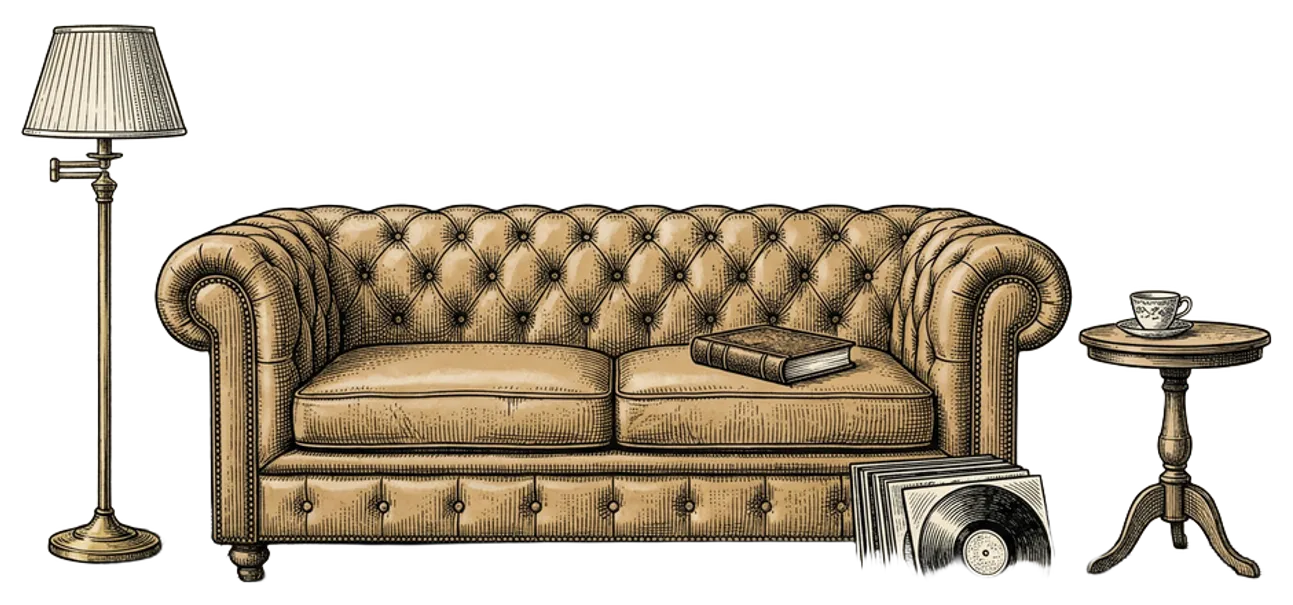



The short answer is: whatever helps you stay there.
An analog room is defined first by what is absent—screens—and then by what makes the absence worth choosing. The common mistake is to start with the look: a vintage lamp, a record player, a pile of beautiful books, a plant that may or may not survive. The result can be handsome and completely unused.
Start instead with the question: what do I want to do here when I am not looking at a screen?
Build around one primary use
Choose one activity as the room's center of gravity.
For reading, you need a chair that does not ask you to leave after ten minutes, good light, a small surface for a drink, and books already in progress. For listening, you need a dependable way to play music and seating oriented toward it—not merely toward a blank television wall. For games, you need a clear table, comfortable seats, and a drawer or shelf where the game is visible. For making things, you need tools that can be started without a twenty-minute setup.
A room can hold more than one activity. It simply needs one obvious answer to "what happens here?"
The useful categories
Most analog rooms benefit from some version of these six things:
- A place to sit. Comfort is not indulgence; it is what lets an activity last.
- Light for the activity. A reading lamp, task light, or window seat is more useful than atmosphere alone.
- A surface. A small table keeps tea, cards, a notebook, or an album cover from becoming clutter on the floor.
- Materials within reach. Put the book, cards, pencils, record, yarn, or camera close enough that starting takes seconds.
- Modest storage. A basket, drawer, or shelf prevents the room from becoming a pile of aspirational hobbies.
- A phone boundary. The phone needs a place outside the room. Without this, everything else is décor.
What does not belong
Do not bring in a television "just for movie night," a tablet "only for recipes," or a phone charger "for convenience." The rule does not need to be moralistic, but it needs to be clear. If the room becomes another place where a screen is always available, it becomes a normal room with nicer lighting.
Avoid buying a collection before you have a practice. Start with what you already own. Use it for a month. Then spend money only on the thing that removes a real obstacle: better light, a more comfortable chair, a small shelf, or a repair to something you already love.
Let it be personal
The most convincing analog rooms are not styled into sameness. They contain the objects of a particular life: a grandfather's radio, a stack of mysteries, a half-finished watercolor, a local card game, a well-used guitar, photographs worth looking at rather than scrolling past.
The room should not announce that you have chosen an analog lifestyle. It should make you want to return to your own life.
Read The Analog Room, Examined for the core boundary, and The Analog Home for the whole-house version.