
In 2025, Americans spent more than a billion dollars on vinyl records — the first time the format has crossed a billion since 1983, when the LP was being killed by the CD. It was the nineteenth year in a row that vinyl revenue grew. Forty-seven million records were sold. Vinyl accounted for more than three-quarters of all physical music revenue. CDs were nowhere close.
You will have read versions of these numbers before. You probably have a guess about what they mean. Most articles on the vinyl revival pick a guess and run with it: vinyl is back because young people are nostalgic, or because the music sounds better, or because the world is rejecting streaming, or because hipsters want a status object. None of these is exactly wrong. None of them is exactly right either.
We want to do something different here. We want to lay out what is actually happening — with the real numbers, the contradictions, and the honest counter-arguments — and then build, on top of all that, an explanation we think will hold up. Because the explanation we keep coming back to is not the one the format's biggest fans tell.
The contradiction
Here is the data point that should bother anyone trying to write a simple story about vinyl.
In 2023, the music-industry research firm Luminate surveyed roughly 3,900 American music listeners. Among those who had bought a vinyl record in the past twelve months, about half did not own a record player. A separate analyst at Futuresource Consulting put the figure for U.S. record buyers at around forty percent without a turntable. Going back further, a 2016 BBC poll of UK vinyl buyers found that forty-eight percent of recent record purchases had not been played at all by the time of the survey, and that seven percent of those buyers did not own a turntable.
These are different studies, different countries, different years. They do not say exactly the same thing, and lifestyle media has been mashing them together for a decade. But the pattern they describe is real, and it should give us pause: the people buying records are not, in many cases, people who listen to records. They are people who acquire them.
A billion-dollar format where half the people buying records don't own a record player is not a market. It is a confession about what people want from music when music has become weightless.
We will come back to what we think it confesses. First the rest of the picture.
How big this actually is
Vinyl bottomed out in the U.S. around 2006 — fewer than a million LPs sold, when CDs were selling over five hundred million. Every year since then, vinyl has grown. The trajectory: under three million units in 2010, about twelve million in 2015, twenty-seven million in 2020. In 2022, vinyl sold more units than CDs for the first time since 1987. Last year vinyl revenue passed a billion dollars wholesale. The Recording Industry Association of America's 2025 year-end report — the source for most of these figures — calls it the nineteenth consecutive year of growth.
In the United Kingdom, where the figures are tracked separately by the BPI and the Official Charts Company, vinyl had its seventeenth consecutive year of growth in 2024, hitting 6.7 million units — the highest in three decades. UK vinyl revenue went from about £19 million in 2014 to nearly £146 million in 2024, a more than sixfold rise in a single decade. Globally, the IFPI reports vinyl growing in eighteen of the last nineteen years.
A few honest caveats inside the numbers. First, the RIAA changed its reporting from retail estimated value to wholesale figures partway through this period, so the famous "$1.4 billion in 2024" and the "$1.04 billion in 2025" figures are not a decline — they are different measures of different parts of the supply chain. Second, the resale and secondhand vinyl market, which is enormous and probably the most culturally interesting part, is not captured by these figures at all. Third — and this matters — vinyl still represents less than ten percent of U.S. recorded-music revenue. Streaming dwarfs it. The vinyl revival is real, durable, and structural, but it has not unseated anything. It has simply refused to die, and grown, year after year, against the grain of every prediction.
Who is actually buying
Here is where the popular telling really goes wrong. The vinyl revival is not nostalgia driven. It is not even primarily middle-aged. According to Luminate, Gen Z listeners — people born after 1997 — are twenty-seven percent more likely than the average music consumer to buy vinyl. The Vinyl Alliance, an industry group whose numbers should be read with that in mind, reported in 2025 that more than three-quarters of eighteen-to-twenty-four-year-olds in the U.S., UK and Germany buy at least one record a month, and that over eighty percent of those Gen Z buyers actually own a turntable and listen.
That last figure pushes back against the "buyers without players" picture in an important way. The story is not that all vinyl buyers are non-listeners. It is that the format has split into at least two overlapping audiences: a serious-listener cohort that owns the gear and uses it, and a wider cultural-object cohort for whom the record is something else — a piece of identity, a piece of decor, a way of supporting an artist, a way of telling yourself who you are.
The most striking single fact about who is buying may be that one artist is responsible for a remarkable share of the whole. In 2023, Taylor Swift's catalog accounted for about seven percent of all U.S. vinyl albums — roughly one in fifteen records sold in the country. 1989 (Taylor's Version) was the first vinyl album to sell a million copies in a calendar year since the tracking firm began counting in 1991. In 2025, The Life of a Showgirl sold about 1.6 million copies — over three percent of all U.S. vinyl by itself, more than five times the year's next-best seller. The vinyl revival, in raw numerical terms, is partially the Swift phenomenon expressed in physical form, and there is no honest version of this story that leaves that out.
But underneath the Swift-driven peaks, the same year-end best-seller lists show something else worth noticing. Alongside the new pop releases sit Fleetwood Mac's Rumours, Pink Floyd's Dark Side of the Moon, Miles Davis's Kind of Blue. Albums that have been in print for forty or fifty years are reliably in the top hundred selling LPs every year. Rumours has made the UK's year-end vinyl top ten for nine years running. The revival is simultaneously a new-release phenomenon driven by young fans and a canon-preservation phenomenon driven by readers — possibly the same readers — who want, in physical form, the records they already know.
The thing nobody made for a while
There is a part of the story that is almost never told well, and it is the most dramatic part.
By the early 2000s, almost nobody was making records anymore. The presses were idle or scrapped. The supply chain for lacquer discs — the masters from which the metal stampers used to press vinyl are made — had shrunk to two companies in the entire world. Most lacquers came from a place in Banning, California called Apollo Masters. The other was MDC, in Japan.
On February 6, 2020, Apollo Masters burned down. Completely. By industry estimates Apollo had supplied seventy to eighty-five percent of the lacquer discs used by every vinyl pressing plant on Earth. Overnight, the global vinyl supply chain had one functional supplier. The fire is the reason new releases throughout 2020 and 2021 took ten months to get to stores, and why a major-label artist who wanted to release a record on vinyl had to wait in line behind a Taylor Swift variant. Jack White — the musician who probably did more than anyone to keep American pressing alive, opening Third Man Pressing in Detroit in 2017 — issued an open plea in 2022 calling on the major labels to build their own plants.
Some of them have. New presses have come online in Tennessee — Nashville Record Pressing, Memphis Record Pressing, an expansion at United Record Pressing — turning the state into the U.S. vinyl manufacturing hub. New lacquer suppliers have begun small test runs. The supply crunch eased, slowly. But it is worth holding in mind that the format the entire culture suddenly wanted was, for several years, being made by a small number of small companies on aging equipment in a handful of buildings. The thing you are buying is closer to a craft object than a piece of consumer electronics. The vinyl in your hand passed through human inspection. Somebody made it.
Record Store Day, and what it kept alive
The independent record store is, against every reasonable prediction, doing well.
In the United States, Luminate reports that independent record stores account for about forty percent of vinyl album sales. In 2024, indie stores sold roughly twenty-three million records. In the UK, the number of independent record shops hit 461 in 2023 — up from 339 a decade earlier, and the highest count in a decade — even as the overall number of UK music-retail outlets collapsed.
Much of this is owed to Record Store Day, which was conceived in 2007 by Chris Brown of Bull Moose Music in Maine and Eric Levin of Criminal Records in Atlanta. The first event ran on April 19, 2008, at about three hundred U.S. stores; Metallica showed up to launch it at Rasputin Music in Mountain View, California. It now runs annually in April and Black Friday, with exclusive limited-run releases drawing queues, conversations, and — by design — foot traffic into shops that survived the format's collapse and now anchor the revival.
What Record Store Day kept alive was not just a sales channel but a place. A counter. A person behind the counter. Someone who could ask what kind of thing you were trying to listen to and point at three records you hadn't considered. The Spotify recommendation algorithm is, mechanically, much more accurate than the person behind the counter. The recommendation from the person behind the counter is, in some way the algorithm cannot reach, more useful.
The hard question: does vinyl actually sound better?
Mostly, no. We are going to be direct about this, because the rest of the argument requires it.
Vinyl's dynamic range — the gap between its quietest and loudest passages — is somewhere between fifty and seventy decibels. CD's is around ninety to ninety-six. Vinyl physically holds less sonic detail than a competently produced CD. Most modern vinyl records are mastered from digital sources anyway; the audio is converted to digital, processed in digital, and only becomes analog again at the cutting lathe. Mastering engineers will tell you, in private, that the "warmth" people attribute to vinyl is largely the result of mastering choices — less compression, more dynamic range left in the mix — and of the gentle high-frequency rolloff and subtle distortion that a stylus introduces. These are real differences. They are not the same as fidelity.
The honest case for vinyl, sonically, is narrower. A record that has been mastered for vinyl by a thoughtful engineer, played on decent equipment, can sound more dynamic than the same album in its mainstream digital master — not because vinyl is technically superior, but because the digital master was probably squashed by the loudness wars and the vinyl master was not. The all-analog audiophile path, where the recording was tracked to tape, mixed to tape, and cut to lacquer without any digital step in between, exists but is a tiny fraction of the market — and even Mobile Fidelity, the audiophile label most identified with that ethos, was caught in 2022 using digital steps in records labeled all-analog.
If you are buying records because you think they sound better than the streaming version, you are sometimes right, often wrong, and almost always paying for the experience more than the fidelity. Which is fine. That is most of what people are paying for. We just want to be clear that "vinyl sounds better" is a defense the audiophile community itself can no longer hold up cleanly.
What we actually think is happening
If the sound argument is shaky and the "Gen Z is nostalgic" argument is wrong, what is the explanation that holds up?
The strongest defensible thesis, the one that survives every objection we can throw at it, is this. People are buying records because streaming has made music feel weightless, and they want to put weight back on it.
Consider what streaming actually delivers. Total catalog access, instantly, for ten dollars a month. Nothing is yours. Albums disappear when licensing deals lapse. The order of tracks is whatever the algorithm decides. The cover art is the size of a postage stamp on a phone screen. You did not choose this song; it played because something else like it just finished. You do not own it. You cannot lend it to a friend. When you cancel the subscription, your library disappears.
We are not arguing this is bad. Streaming is, on balance, a miracle. The argument is narrower: a thing that is infinitely abundant and effortlessly accessible has, for the human brain, almost no weight. It does not anchor a memory. It does not occupy a shelf. It does not pass between hands. The marginal value of any one stream approaches zero — because it has been arranged that way, on purpose, so that more streaming will happen.
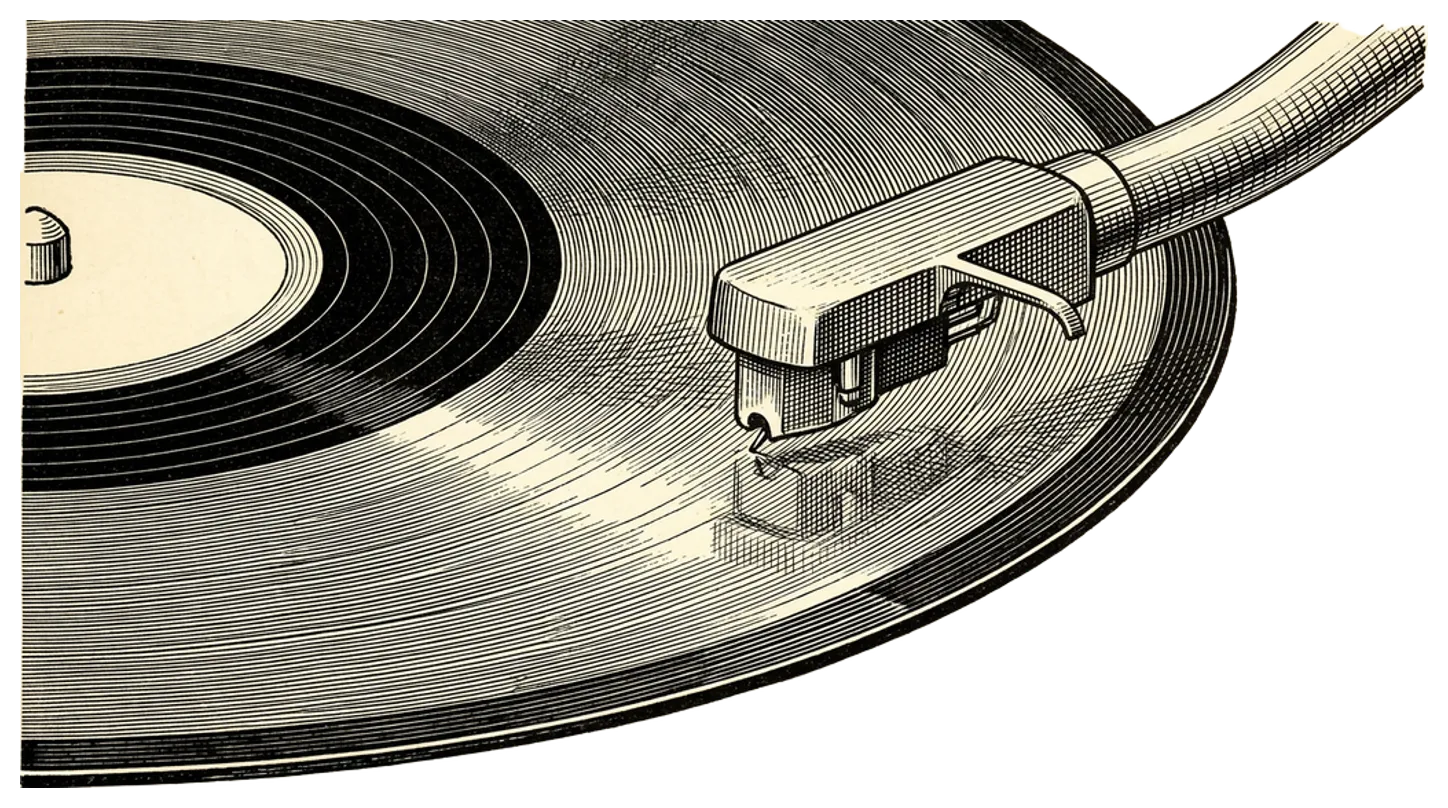
What a record does, in response, is restore the friction. You select it. You hold it. You read the liner notes. You set it down on the platter, hear the small crackle of the needle finding the groove, listen to one side and then deliberately walk over and flip it. The album sits on a shelf afterwards. You can lend it to a friend. You can pass it to a child. If the streaming service goes out of business, you still have the record. If the artist disappears from the platform, you still have the music.
That is the cultural argument, and it scales. It explains why the people who do not own turntables are still buying. It explains why Gen Z, the most-online generation ever measured, is leading the comeback. It explains why catalog records sell year after year. It explains why album-cover art has become a TikTok aesthetic.
Vinyl is what music ownership looks like in a culture that has otherwise rented all its music. The fact that some people buy the ownership without playing the music does not undermine the argument. It strengthens it. They are buying the thing the streaming subscription cannot give them, which is something to keep.
This connects to a broader case we have been making across the site — for paper rather than apps, for owning the tools you use rather than renting them, for a calmer relationship with the devices in your home. The vinyl revival is the music-shaped expression of the same impulse. People are not rejecting the digital. They are rebuilding, in physical form, the small handful of things they want to actually have.
The honest concessions
A few last things to keep the piece honest.
Records are expensive. The average price of a new mint LP rose to about $37 between 2020 and 2025, per Discogs. Decent turntables start at $200 and the audiophile upsell is bottomless. Almost a third of Gen Z record buyers told the Vinyl Alliance they have cut back or stopped because of price. This is a problem the industry is making worse by releasing eight variant pressings of the same album to fandoms that feel obliged to collect them all.
Records are environmentally costly. PVC is fossil-fuel-derived and effectively non-recyclable; researchers at Keele University have estimated about half a kilogram of carbon dioxide per modern record, though the comparison with streaming is contested and depends entirely on how many times you listen. Billie Eilish, herself a vinyl-loving artist, called the variant-heavy commercial machine "so wasteful" in a 2024 Billboard interview, before noting that she releases variants too and that these are "industry-wide systemic issues."
And yes, some people buy records and never play them. That is a real fact about the market. We do not think it should be embarrassing. The book on your shelf you have not read yet is also, in some sense, a piece of furniture — and also a quiet announcement of who you are trying to be.
A practical note, if any of this lands
If, having read this far, you find yourself wanting to start — or restart — a record collection, we have written an honest comparison of beginner turntables that includes the strong argument that the best turntable is the one you can find used at an estate sale. The point is not the gear. The point is that one of the things on the shelf in your home, in your life, is something you chose, that nobody can take from you, that does one thing slowly and well, and that asks you to sit with it.
That is what records are doing in the world right now. That is why so many people are buying them — including, in growing numbers, people who were not even alive the first time the format went around. The story is not nostalgia. The story is what people reach for when everything else has gotten light.