

The phrase "a quieter home" sounds like a marketing concept, and we want to be honest about that before we go any further. It has been used to sell candles. It has been used to sell linens. It has been used to sell — and we mean this as a compliment to whoever wrote the copy — twelve-hundred-dollar wool throws. The phrase has been worked over by enough lifestyle brands that it now carries a faint smell of merchandise.
We are not going to use it that way. We are going to use it to mean a specific thing, and the specific thing is not aesthetic. It is structural. It has nothing to do with whether your home is beautiful, decorated, photographed, photographable, or anything else you can buy. A quieter home, the way we mean it, is a home in which fewer things are competing for your attention than is typical. That's it. That's the whole definition. The rest of this piece is what it looks like in practice.
We have written, over the past few months, about phones and screen time and paper and records and film. Each of those pieces makes a small argument about one piece of furniture in modern life. This one is the piece that puts them together, because the pieces add up to something, and the something is the kind of home where the previous arguments cohere. Which is not a quieter home in the candle-and-throw sense. It is just a home that has gradually been arranged around a different premise.
What we mean by quiet
It will help to be precise. Quiet, as we mean it, is not the absence of sound. A house can be objectively silent — no music, no television, no human voices — and still be deafening. You can sit on the couch in such a house, with your phone face-down on the table, and feel a low pressure in your chest the whole time, because the phone is not actually face-down on the table. It is waiting. It is going to vibrate. Or it isn't, and the not-vibrating is somehow its own kind of noise. The room is silent and your attention is being held by something the size of a deck of cards on a coffee table.
Quiet is not the absence of sound. It is the absence of the small persistent feeling that something, somewhere, is trying to get your attention.
A home where things are not trying to get your attention is a different kind of place to be in than a home where things are. The difference is not always obvious from the inside, because we live our whole lives in homes of the second kind and we calibrate to them. The difference becomes obvious when you spend a few days in a home of the first kind — usually somebody else's house, somewhere a little remote, where the wifi doesn't quite work and the dishwasher doesn't beep and you can read a whole book in an afternoon. People come back from such places saying things like it was so peaceful — but the peace, examined, isn't really about the view or the air or the linens. It's about the fact that nothing in the house was making a quiet bid on their attention. Their attention, for once, had nowhere it was being pulled.
Most homes today are arranged the other way. Almost every object in the room is, in some small way, a recruiter. The phone wants you. The television wants you. The Echo on the kitchen counter wants you to ask it something. The smartwatch wants you to glance at it. The notifications on the laptop are queued up for the next time you walk by. The smart fridge — if you have such a thing — wants to tell you about your milk. Even objects that aren't electronic have been quietly enlisted: the unread book on the side table is reproach; the unopened mail on the counter is obligation; the half-finished project in the corner is a small daily debt. The room has been turned into a roster of small claims against your attention. The room is loud.
What we want to describe is a home where most of those claims have been turned down or moved out, and what fills the space they leave.
What it looks like, room by room
Let us be concrete. We have been writing in the abstract long enough.
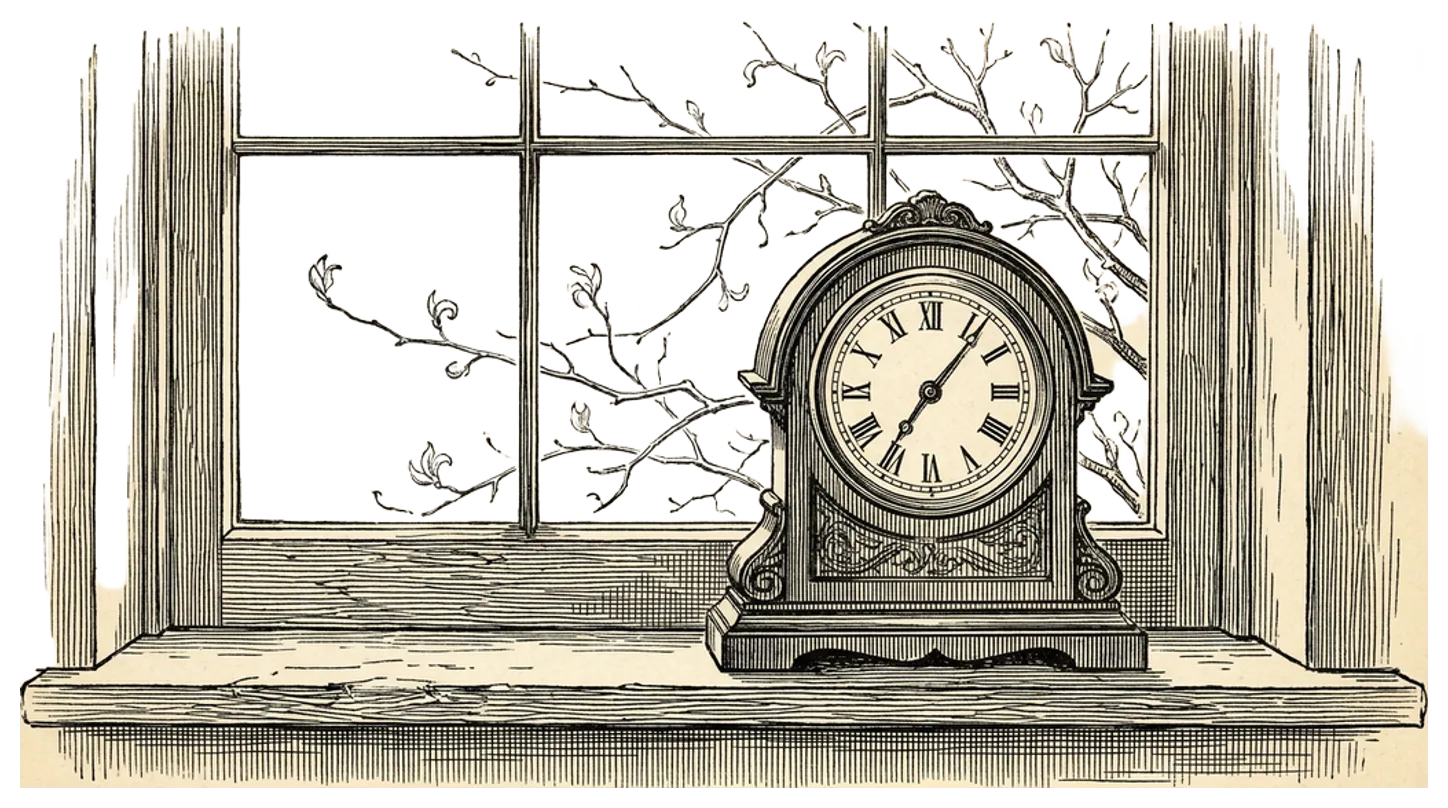
The kitchen. A kitchen in a quieter home has a counter with no Echo on it. There may be a kettle. There may be a small radio — radios are an oddly underrated technology in this conversation; a radio plays you what's on, requires no decisions, asks for no attention, and stops when you turn it off. There is a clock on the wall, the kind with hands, which tells you the time without offering you anything else. There is, on a hook or in a drawer, a paper grocery list someone is adding to with a pencil. The phone is not in the kitchen, because the kitchen is where people stand and talk while one of them is cooking, and a phone in that room is a third person trying to get into the conversation.
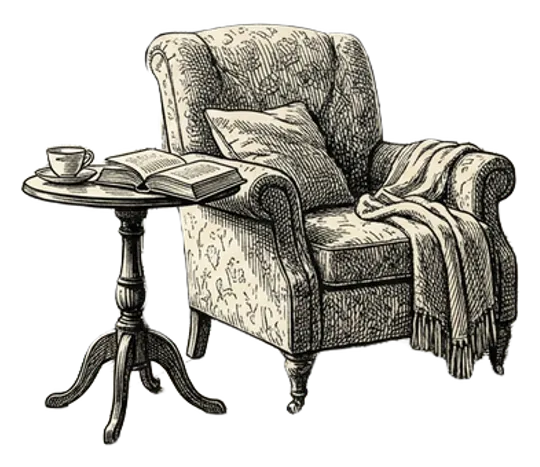
The living room. The television is on a wall or in a cabinet and not on. It is off most of the time. When it is on, someone has chosen what to watch and is watching it; nobody is "scrolling on the TV." The bookshelves have books that the inhabitants have read or are going to read; the books are not décor. There are records, perhaps, on a low shelf. There is a record player on a higher one. There is at least one chair that is not facing the television — that is facing, instead, a window, or another chair. That chair is the test. A house that has at least one chair facing nothing but a window is a house arranged for thinking. A house in which every chair faces the television is a house arranged for being shown things.
The bedroom. No phones, as much as possible. A clock — the same kind with hands — and a lamp, and a book. The bedroom in a quieter home is the room that has been most aggressively cleared, because the bedroom is where the day starts and ends, and a phone is the wrong way to start or end a day. There is a small concession to be made here: if you are a parent, you keep a phone in the room for emergencies, and that's fine, but you put it in a drawer. The drawer is not a hack. It is a small architectural fact about the room that says this is not where the phone lives.
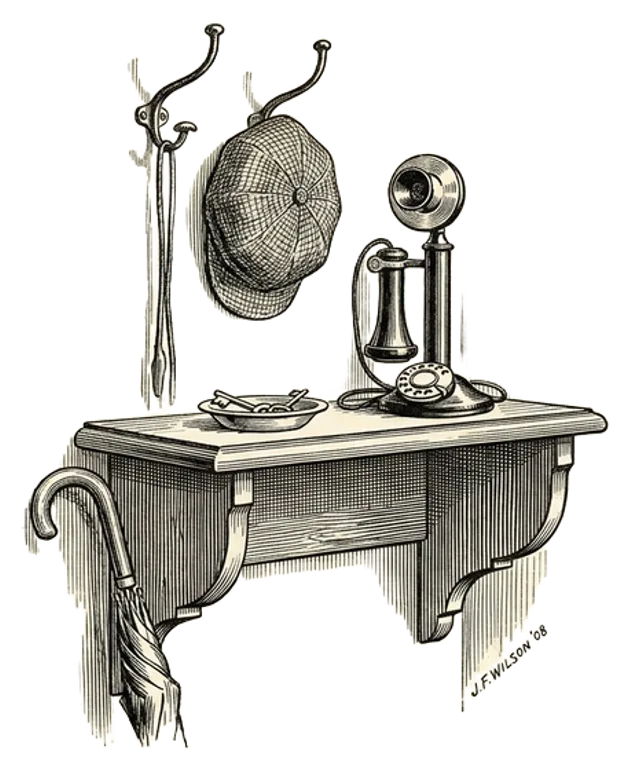
The hallway, or the front door, or the entry. A hook, or a small dish, or a shelf — a piece of furniture whose entire job is to hold the phone when you walk in. It does not have to be elegant. It just has to be there. A house where the phone has no place to live is a house where the phone lives wherever you happen to be standing, which is to say, the phone lives in your hand, which is to say, you never put the phone down. Buy the cheapest shelf you can find. Put it inside the front door. Train yourself to use it.
The home office or workspace, if you have one. This is harder, because the screen is the work. We do not pretend otherwise. But the room can still be arranged to be quieter in the limited ways available to it: a window where you can rest your eyes; a notebook where you can write things that don't need to be on a screen; a closed door at the end of the day. Closed doors matter more than they sound. A quieter home is a home where some rooms can be left.
We could go further. We will spare you the linen closet.
The reason this is the piece we wanted to write
We did not, when we started this site, intend to end up arguing for what is essentially a philosophy of the room. We intended to write reviews of dumbphones and turntables and notebooks. The reason we kept ending up at the room is that the gear, taken individually, doesn't work.
We have read enough of our own product reviews to be honest about this. You can buy the Light Phone and use it for two weeks and slide back to the iPhone, because the rest of your life is still organized around being interruptible. You can buy a record player and never play it, because the couch faces the television. You can buy a paper planner in January and abandon it in February, because the calendar app on your phone is the path of least resistance and the planner is on a shelf you don't walk past. The individual gear is downstream of the room. What you actually need to change is what the rooms ask of you. The gear is just the prop list.
This is what the four other pieces on the site have been quietly building toward. We have been making the case for paper because paper changes what the desk asks of you. For records because records change what the living room asks of you. For film because film changes what the camera asks of you. For dumbphones and digital detoxes because the phone changes what every room asks of you, and the phone is the most powerful piece of furniture in the house. Each of those pieces is, in a sense, the same argument applied to a different room.
The reason the room frame matters more than the gear frame is that the room is durable. A new piece of gear is an act of willpower; a room is an architecture. The gear has to fight the room every day, and most days the room wins. But once a room is arranged differently, you don't have to fight anything. You just live in it. The room does the work the willpower would otherwise have to.
What it does not mean
We want to head off some failure modes here, because the phrase "quieter home" attracts them.
It does not mean austere. A quiet home is not a monastery. It is allowed to have color, and clutter, and life. It can have children's drawings on the fridge and a chaotic shoe situation by the door. The thing we are turning down is not human warmth. It is the small daily volume of objects that are competing for our attention.
It does not mean expensive. Almost everything in this piece is free, or close to it. A cheap clock with hands costs ten dollars. A hook by the door costs five. Turning notifications off costs nothing. Moving the Echo into a drawer costs nothing. The economy of the quieter home is not the economy of merchandise — which is, again, what most lifestyle media gets wrong about it.
It does not mean anti-technology. We are not going to pretend the laptop doesn't belong in the house. It does. The argument is not about whether technology is in the house — it is — but about whether the technology is asking us for things or whether we are asking it for things. A laptop in a desk drawer, brought out for work, is a tool. A laptop open on the couch all evening is a roommate.
It does not mean quiet for guests. We want to flag this specifically because we have seen the failure mode. A house that is performatively quiet — that prides itself on being quieter than its visitors' houses — is, in its own way, loud. It is making a point at you. A truly quieter home is one nobody walking in would necessarily notice. It just feels like an unusually nice place to spend an afternoon.
And it does not mean static. The arrangements we are describing are not a one-time project. They drift. Phones creep back to the bedside. Notifications get re-enabled by an update. New gadgets arrive as gifts and stay. The work of keeping a home quieter is small and ongoing, and you should expect to be doing some version of it for the rest of your life. The hope is not perfection. The hope is that the baseline of the room slides, over years, in the right direction.
A small inventory, in closing
If you want a starting place — not a checklist, not a manifesto, just a few things we have seen make the largest difference for the smallest cost — these are them.
A clock with hands, somewhere central. A radio in the kitchen. A hook by the door for the phone. A drawer in the bedroom that becomes the phone's nighttime address. A chair somewhere in the house that faces a window. One paper notebook, on a desk where you will see it. One book on the side table, open to where you left it. The smart speaker, moved to a back room and used less, or removed and replaced with the radio and a five-dollar timer from a hardware store — we wrote separately about that one. The smartwatch, if you have one, taken off in the house.
Notice what is not on this list. There is no candle. There is no throw. There is no twelve-hundred-dollar wool blanket. The list is mostly removals. A quieter home is mostly made by subtraction — by deciding what is allowed to ask you for your attention and what is not. The rest of the home, what's left when you've done the subtraction, is the part you already have.
We have ended up, in writing about it, more attached to this idea than we expected to be. We started this site to recommend products. We are ending up, more often than not, recommending arrangements — small structural changes to the rooms people already live in, made with things they already own. This may be the more honest version of the work. It's certainly the cheaper one.
A home arranged this way is not a retreat from the world. It is more like a place from which the world can be approached on terms you've had some hand in setting. The phone goes in the hook by the door. The light comes through the window. You sit in the chair that faces the window. Whatever you do next — read, write, think, talk to whoever is in the room with you — happens in a room that is no longer running a small daily campaign against you. That is the whole idea. It is not a brand. It is just a house with the volume turned down on the things that were never supposed to be that loud in the first place.